Derya and I don’t know each other yet when we meet to talk about her photos. A few weeks before, I am sitting with a group of women who meet every Wednesday, eat together, drink coffee and talk about things that are happening in the city or in their lives. When I talk about the project I am working on, one of the women approaches me. She says that her daughter loves taking pictures and she could imagine that she would enjoy taking part in the project. I give her a camera and my phone number and tell her that her daughter should contact me. A few days later I get a call from the daughter, Derya. She has a few more questions, we talk briefly and I ask her if she would like to take part. She would like to.
Now I am standing in front of the family’s flat; Derya and her two sisters open the door for me. We introduce ourselves and the three of them guide me into the living room, where the little brother now also joins in and plays between his siblings. The sisters seem cheerful and open-minded, especially Derya is curious about the photos. I ask the girls how old they each are. Derya is thirteen, the sisters are older: fifteen and eighteen. While one of the sisters gets something to drink from the kitchen and puts a plate of fruit and biscuits in front of me, the older brother also pokes his head into the living room briefly and says hello. He is nineteen; the youngest brother is ten.
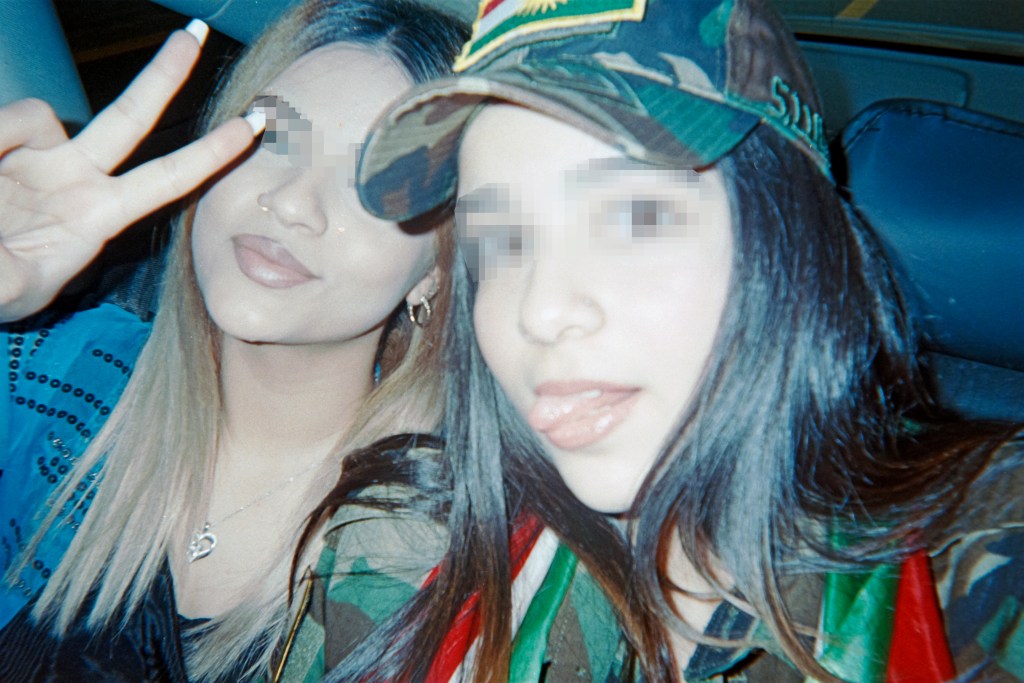
I take out my recorder and start talking to Derya. Then, I put the first picture between us. The photo shows Derya and one of her sisters. „This is in her room,“ she explains to me. All the children have their own room, but Derya is actually in her sister’s room more often than in her own. I ask if the three sisters are very close. „Most of the time, sometimes not,“ she grins. „What was it like when you were smaller?“, I ask. „It was better then!“
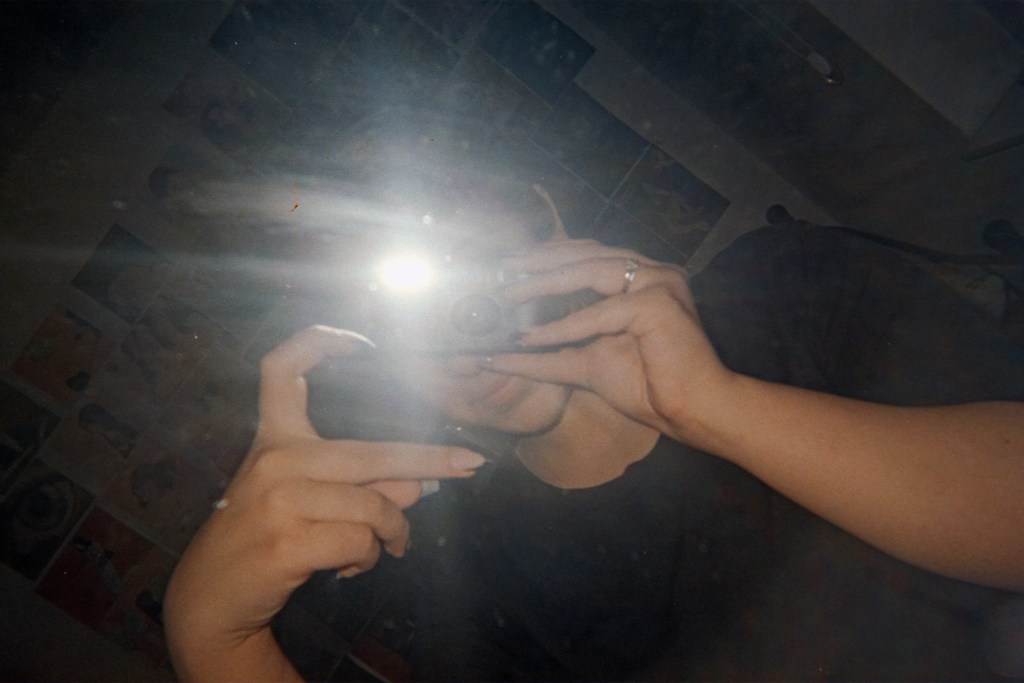
The next picture shows her. „That was a special day, a Kurdish day,“ she explains, „it’s a tradition: Newroz – how can I explain it? It’s like celebrating this country all over again. I think I took a lot of photos that day,“ she says with a laugh. I ask if her family is from Kurdistan. „We all came here together. We have been here in Germany for seven years approximately.“ I ask where exactly she was born. She is not sure, doesn’t really remember that time. „And can you remember how you got here, what it was like in the beginning?“ – „Yeah, we fled. So we got up and then we ran. And yes, then we went to Turkey by car.“ I ask her if she knows the reason why they fled. „That just – I don’t know, but I think it was the Arabs – they attacked and that’s all I knew.“ – „At the place where you lived?“ – „Yes. All I know is that a 16-year-old boy knocked on our door and said that there was something going on and that we should get out and run away.“ For three years the family lived in Turkey. „That was nice. So that was really very nice.“ – „Was it difficult to leave Turkey and then come to Germany?“ – „A bit. But that was also nice, the time when we planned everything and so on.“ In the beginning, the family lived in a village near Stuttgart. „Then we moved here. But we went to a lot of shelters before we came here.“ Since they moved to Essen, they have been living here in the neighbourhood. „Well, I like it very much. Sometimes it’s quiet, but sometimes there are problems.“ – „Like what?“ – „There are often police or ambulances here.“ Her school is also located in the neighbourhood. She is now in sixth grade. „I think I had to redo a school year twice, or once, I don’t know. And then we moved several times, that’s why I’m still in sixth grade now.“ She gets along well with her class mates.
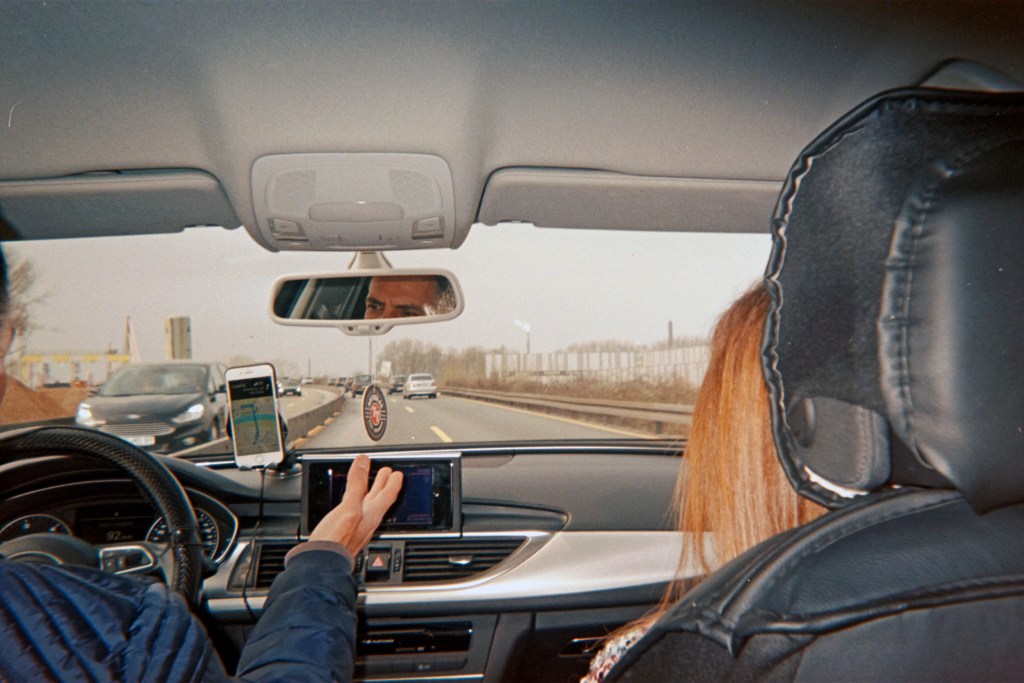
We continue to talk about origins. When someone asks her where she is from, Derya says she is Kurdish. I ask her if Kurdish identity is a big topic in the family; she answers that it is not. „Do you generally talk a lot about home and things like that?“ – „Well mostly the topic that’s really big with us is Islam, so the mosque and everything, religion.“ – „Are you religious too?“ – „Yeah, I am.“ – „Do you also go to the mosque?“ – „I wanted to, well I still want to actually. But I haven’t found the right mosque yet.“ I ask if she has any friends who go to the mosque that she could go with. „My friends and I don’t talk about Islamic things like that very often.“ – „And your brothers and sisters, do they go to the mosque?“, I ask. „My brother, no one else. My parents don’t either. My brother is very, very religious. In a way that it’s also sometimes exaggerated. He goes there quite often.“ I ask her if that bothers her sometimes. „Sometimes he’s like, ‚You’re not allowed to do this, you’re not allowed to do that‘. That is kind of – you know!“

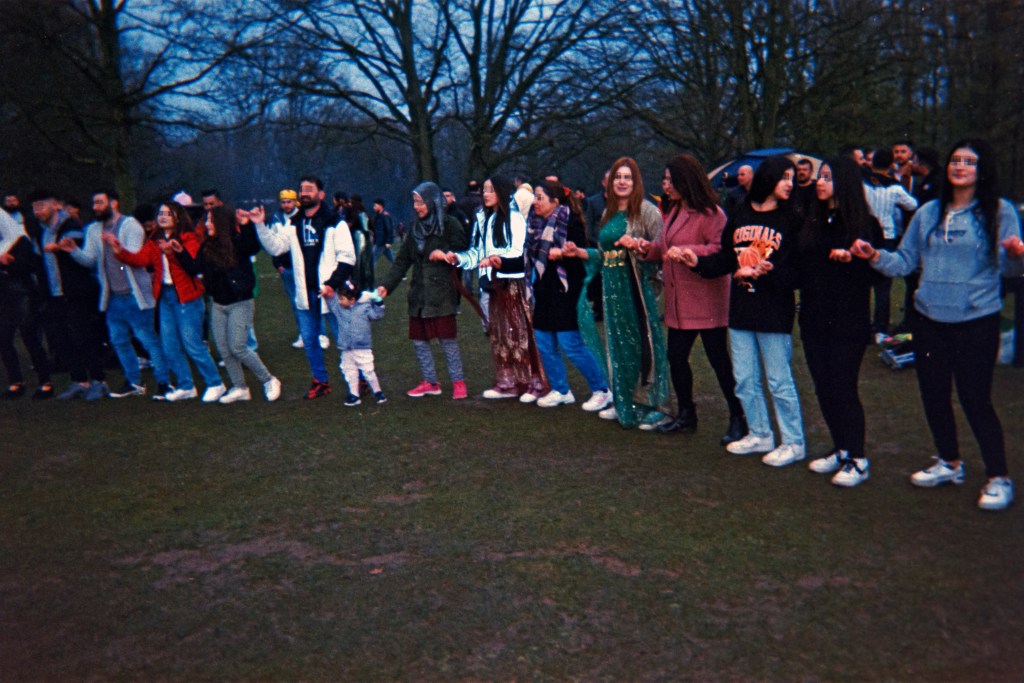
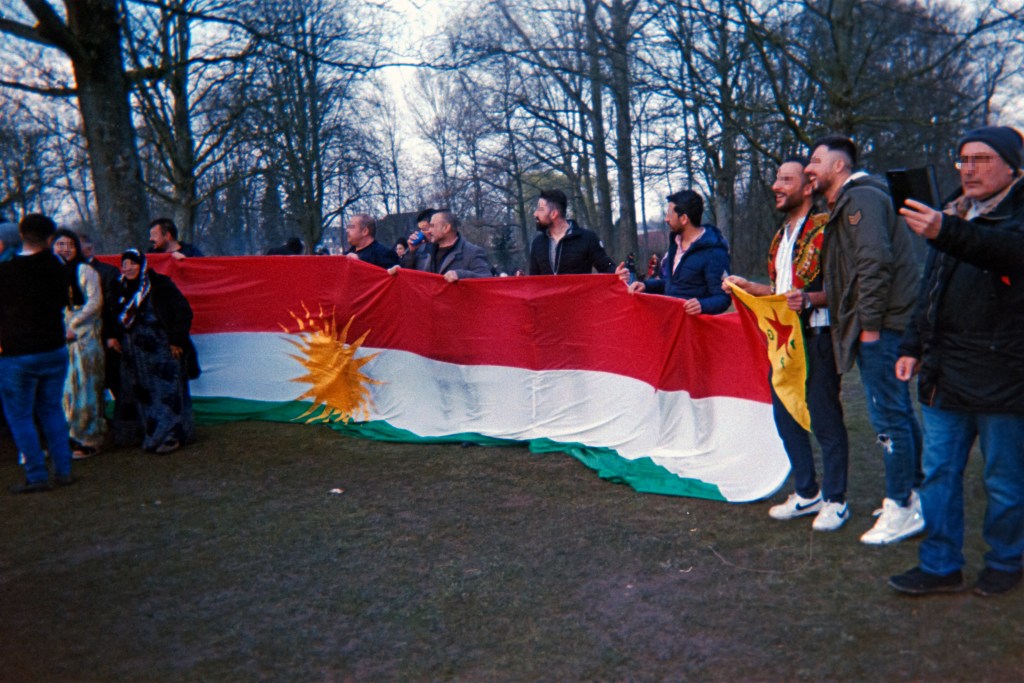
The next photos were also taken on Newroz. Together with friends and neighbours, the family went to a place where many people celebrated together open air. There was a bonfire, music was played, singing and dancing took place. I ask Derya if she likes that: singing, dancing, celebrating. „Yes, I like it very much! We have weddings coming up soon now, and I’m really excited about that!“ She laughs and adds, „It’s just the way it is with me, I just go there to eat cake and dance. Our dances are just special to me.“

The next photo was taken during an excursion she made with a friend organised by a youth centre. The centre is right next to her school; she meets there regularly with her friends in the afternoons. Sometimes they cook, sometimes they watch movies or just chat. Some of the people there are older, some younger than her – everyone is welcome to bring along friends. The excursion was the first one she went on. For three days they were in the forest and spent the night in huts. They went hiking, played games – „the things you always do when you go on a school trip or something.” She enjoyed the trip, but she doesn’t know yet whether she would go on the next one. „Well, they said we’d go to Austria next time, but I don’t think I’ll go.“ – „Why?“ I ask. „I think it’s too far for me.“ – „Do you think you would miss your family then?“ – „Yes, I think it would be for three weeks.“ She has no special plans for the upcoming summer holidays. The family is staying here but wants to go on a few trips. „By then, our mother will have the car, too.“ Her mother is currently obtaining her driving licence, Derya tells me. Besides the driving lessons, she is also taking another German course. The parents find learning German much harder than the children who came here while they were young. „It was very easy for me, I learned it very quickly,“ Derya says. After only half a year, the children speak German. She speaks German with her siblings and friends, and Kurdish with her parents.
I ask her what she would like to do when she has finished school. „I decided that I want to be a beautician and if I don’t manage that, I will become an actress.” I ask if she has any experience with make-up. Her sister, who has just rejoined us in the living room, points to Derya’s face with an obvious hand gesture and we laugh. Her make-up looks very professional, her nose piercing suits her well – obviously she knows about cosmetics and styling. I ask her sister the same question. She is also still at school and tells me that she has always wanted to work in the health sector. She just did a three-week internship at the university hospital. She really likes the work, but she can’t imagine working only in a hospital. „The working hours there are a disaster!”
Once her sister has left the living room again, we look at the pile of photos again that now lies between us and that we have looked through completely. I ask her if she feels like she can recognize herself in the pictures, if the photos represent her in a way in which she sees herself. „If I were to ask you, what are you like as a person? How would you describe yourself? Or what makes you who you are?“ – „I thought taking the pictures was important; I take a lot of photos and videos during the day. I would describe myself like this: I’m a very kind person, in my opinion. I have a pure heart. I am also shy most of the time. And apart from that – well, I’m not really aggressive.“ I ask about the photos and videos she takes. She tells me that she posts a lot on Tiktok and Instagram. „And is that easier – because you said you were shy too – but do you find it easier to share stuff there?“ She nods. I ask what it’s like for her to get feedback there. „Well, that feels very nice because most of the time I get a lot of compliments.“ When she gets compliments in real life, she usually blushes, she tells me. She enjoys taking videos: music, dancing, pretending to sing to the songs. She likes to sing and wanted to be a singer once. „But I don’t think it’s going to work out. Because I don’t know, I often sing, but then sometimes there are people who tell me: ‚It’s not so nice‘ and then I feel guilty and I don’t feel like it any more. But when I’m alone, I sing.“ – „Who said that?“, I ask. „Sometimes friends, sometimes my siblings, just for fun though. But I just take things too seriously, even if it’s fun.“

Derya also enjoys acting; she was in an acting group at school until it was cancelled. „I like films and especially TV shows, and I would like to be in one of them.” However, she likes make-up even more. „So my friends often tell me that I’m very good at it and that I should do their make-up.“ I ask her if she sometimes does her sisters‘ make-up too. „No. My sister is a bit better at it than I am. The other one doesn’t wear make-up at all, she really doesn’t like make-up. She’s more of a natural girl.“ I ask if she can remember how she got into make-up. „I used to be at home a lot and then my sister wasn’t at home, so I often went to her make-up table and tried things out,“ she grins. When I ask her what she would rather do if she had to choose between make-up and acting, she answers without hesitation: „Make-up!”
We talk about how Derya – being a thirteen-year-old teenager now – sees herself. „I would say that I am grown up, that I am older. I think I’m mature enough to know what I’m doing. And that I shouldn’t get told all time that I’m childish or that I’m thirteen by not-so-real friends. Because there are always friends who say: Yeah, go away, you’re thirteen! You’re like a child.’“ That bothers Derya. Her parents, she believes, still see her as a child. However, this does not cause conflicts. „The only problem is that I like to wear wedding dresses a lot and they are usually not for my age. But that’s the only thing that bothers me, nothing else.“
Among the siblings, age represents a kind of hierarchy. „My siblings are very mature, more mature than you would think of 18- or 19-year-olds. And they often teach me things that made me become so mature.“ – “What kind of things do you mean?“ I ask. „What you shouldn’t do or what you should do in the future. Or how to deal with friends who are perhaps not so good for you. And that you shouldn’t listen to everyone. Because I’m someone who always asks everyone how I should do this, whether I should do this, whether this is good.“ She wants to learn to listen more to herself and not so much to what people around her say. She feels that people are always telling her to do something differently from how she thinks it’s right.
I ask her what makes her think that her sisters are so mature for their age. „My middle sister is like that because of my aunt. I also learned a lot from my aunt“ – „Does she live nearby too?“, I ask. „She died.“ Five years have passed since her death; she was the twin sister of Derya’s father. „She was very important. She was the one person who really helped a lot when you were in difficult situations with the family.“ – „With your parents?“ – „Nah, not like fights, but like … like little problems, like – I can’t really explain.“ – „Okay, and she was just always there like that?“ – „Yes!“ By now the family doesn’t talk about her that much anymore.
I ask Derya what it was like for her parents when they arrived here. „Very difficult. They fled with my grandma, my aunt and my grandpa. My grandma couldn’t walk well. So I don’t know how she felt about it, but my mother went through a lot. My father as well.“ Her grandpa is also no longer alive. Her youngest brother was born after they fled to Turkey. I ask her if she also speaks to him in German. „He can’t talk very well because he has an illness, but he can communicate.“ – „In German?“ – „Both.“ There is a painted picture of him on the wall next to the couch where we are sitting.
We talk about the different places Derya has lived in and I ask her where she would want to live if she could choose. „Right now my wish is to live in a village. But I think that when I’m a bit older I’ll live in a city. But not in Germany, but either in Turkey or in England.“ – „And why a village?“ – „I like it when it’s quiet and there’s a lot of green. And I like it when people don’t live in flats, but in houses.“ I ask her if she has ever been to England. She shakes her head. „I’ve never really been on holidays like that.“
What else does she imagine when she thinks about her future? What does she see when she imagines what her life will be like when she is twenty? „Well, I think I’d still be with my parents, but by then I’d like to be engaged. If I have a boyfriend by then.” – „Is that something you’re already thinking about? Engagement and your own wedding?“ – „Yes,“ she grins. „And have you ever been in love?“ – „Yes, but more like ‚he’s beautiful‘ – that kind of thing,“ she grins broadly again.
I finish my glass of water and before I leave, I talk briefly with Derya’s mother. She signs the documents for the project and leaves the living room again. The three sisters walk me to the door together and stand in the doorway again, the three of them, while I put on my shoes. I say goodbye, until the next time.
 Projekt "Perspektive(n) Mensch"
Hinterlasse einen Kommentar