Philipp and I have known each other for a while. During the pandemic, we met in the garden of a mutual friend. A few weeks ago, I write to him, tell him about the project and ask if he would like to participate. Today we meet for the third time in his flat in Wattenscheid – the first time I gave him the camera, the second time I picked it up. Today the sun is shining, the first nice day in a long time, and he suggests going to the park for the interview.

When we sit down on the blanket he brought with him, he asks if I have the photos with me. I do. „Cool!“ he exclaims in anticipation. I take out the pictures. „Where is this?“, I ask at the first photo. „That’s in Witten. At work. Our group room. There was a table football and a pool table. And I thought the location was mega nice. Because you had a lot of space to run around with the kids and so on.“ At that time, he was conducting Potenzialanalysen with young people. One of the many social jobs he has done in recent years. „I went there on my bike with my camera and actually wanted to see every location – because you asked me what it was like, perspectives in life. So I thought about it. And I thought a lot about what my life is like. And since work makes up a large part of life – in terms of self-reflection, I am what I do. And that’s why I think work is a very big part of being. And that’s why I actually wanted to photograph all the different workplaces where I have worked in the past. But at some point, I didn’t continue with that.“ He knows very clearly what he wants to do with of his work: „Promote social activities where it is a matter of giving the young generations the opportunity to enter life in the best possible way. On different levels, that is. In the educational context, for sure. In the social context – giving back fun, joy. I see myself more as a social education worker.”
With the term “work”, Philipp refers to various things: voluntary and full-time work, paid and unpaid. „Wages are a difficult thing anyway. I think there should be a basic wage so that you don’t have to worry about wages anymore. That is, about money.“ But especially in the social sector, he sees the financial situation as very difficult. „It should be the case that what you actually do – if you also do something in the social sector – you can live off it. And I think that’s where a lot of people in our generation have problems, that you then have to rely on other means that you wouldn’t otherwise like to use.“
He doesn’t have a job at the moment. On the way to the park, he tells me that without a job he is finding it difficult to structure himself. „The time. To value the time. So I manage a higher workload than when I’m working, but it’s not used that effectively, no?“ Philipp talks about boredom, that it makes him restless. „I’m the type who sometimes gets fidgety.“ He wishes he could endure boredom better, that he could simply do nothing for hours – „in the depths“. „And that during these hours you don’t have to deal with any fucked-up things, but can just enjoy. And I think enjoying has become really difficult nowadays. To enjoy time. And in my analysis, that’s also largely due to the social structures that prevail here in Germany. Because your thoughts often revolve around it and you’re caught up in them because you’ve had to focus on them for two and a half years or so, because that’s what happened to you. Then it’s difficult to relax and enjoy the time and wish that you had more of it, because you actually want it to be a historical chapter that is closed, but that doesn’t happen by itself.” The historical chapter he wants to close in his life is his personal experience with the German welfare system. An experience that has shaped him and that he is still dealing with.
Philipp is in favour of a universal basic income and against the Hartz IV system, „because the Hartz IV system makes it difficult to live a human-rights life, because you have so much work because of it, are projected into so much stress, that it almost takes up a part of your life. And it should just be something you don’t worry about. To be able to focus your thoughts on better things.“ His criticism of Hartz-IV is very clear. „It’s the amount, for one thing – it’s simply too little. “ A basic income, „which you get when you’re not on a wage, shouldn’t be so low that you have problems sustaining yourself with it.“ The other aspect is the way Hartz IV is implemented, „all the implications attached to it, with all the measures and restrictions and so on“.
But it doesn’t stop at this sense of injustice. „I am of the opinion that you have to change it from the inside. And you have to show from within how you can do things differently. And then, of course, deal with all the consequences that that has.“ Something should change. „I thought about a lawsuit where we as consumers in the social system are not being served, and that has different consequences for us. In my case, it had serious health consequences: bipolar disorder, stomach pain and even the fear of death. And in the end, I lost my job because I was obviously no longer mentally fit.” During the pandemic, he contacted a lawyer in Great Britain, they exchanged a lot of information, prepared a lawsuit, and wanted to sue at the European Court of Human Rights. „That’s six independent lawsuits, all suing the same thing. And after that we wanted to bring this forward as a class action and compare it with a tariff table. Because I am sure that I am not the only person who has not been paid by the social structures and has health restrictions as a result. Although I have fulfilled my duties. You simply can’t keep that up, the Hartz IV system, it’s no longer sustainable.“ He is sure: „We need a new social system in Germany, and that could have been sued for.“
But it does not come to that. The lawyer falls ill with covid and dies. Nevertheless, Philipp has not given up on the issue. What is lacking right now is money to hire lawyers to push the process further. When he has work again, with the association he is founding, and is financially independent through his work, he wants to focus on the lawsuit again.
While we drink coffee from the thermos flask Philipp has brought with him, we talk about how it all came about, about the lawsuit, about the situation he found himself in almost two years ago, which he wants to come to terms with but which is still bothering him. In his early 20s, he moved to Vienna, studied and worked there for a total of six years. „That’s how my young-adult thinking was shaped.“ He perceives the structures of the state very differently than in Germany. „I was very shocked when I returned to Germany that this is what it looks like here. Because here everything is made difficult, you always have to do everything twice and three times, you are called to account for everything. And that is very, very unpleasant. You are always in distress, you feel so attacked.“
After his studies in Austria, he continues his education in Germany, does postgraduate training, works part-time at a foundation. When he loses this part-time job, he is not too worried. He applies for Hartz-IV and already has an employment contract for a full-time job, which he should start within the next few months. The next big step in his life: a permanent position with a large NGO in development aid. He prepares to emigrate to Georgia for the job, getting papers and documents ready. But meanwhile, the job centre doesn’t pay, for two months. For two months he cannot pay his rent, has expenses, also for the preparations for emigration. „And then I had problems with it, because for eight months they simply didn’t give me two months of these payments and I just couldn’t pay any more rent, just before the emigration. I had an employment contract as a project manager, actually life had finally blossomed after my studies, employed, happy. And then it was all ruined by the fact that I had so many debts because I didn’t have enough money for two months.
The job centre does not respond to his letters. At some point Philipp writes to them, „that something like that can also cause suicidal thoughts, if you lose everything else because of it.” He never gets a reply. He doesn’t get any help from his future employer either; he wishes for support, for example in the form of a letter from a lawyer. Philipp feels increasingly bad about the situation, he can’t sleep well, gets stomach pains. The pain gets so bad that he is scared to death. The scar he has had on his stomach since an operation when he was a baby hurts so much, „as if it were bursting open from the inside, that’s what it felt like. And I didn’t get an endoscopy, but a false diagnosis that it was a hernia.“ Again, he is not helped, the pain does not go away; neither does the anxiety and the sleeping problems.
Philipps future employer has a crisis manager whom he knows from the seminar that is supposed to prepare the employees for emigration. „He said we could call him 24/7 if anything happened. Then one night at one or two o’clock, slightly drunk, I asked him: ‚What if the Russians invade Georgia and I’m stuck there and feel hardened between the fronts? Because part of my bloodline is Russian, old Russian. And then he said, ‚You’re mentally ill! Dude, what’s wrong with you?!‘ Then I told him that I can’t sleep well because I have such thoughts right now. And then he called my parents and then my parents came over and said I should go to the psychiatric ward and so on. And then I was in the psychiatric ward for one night, but I left straight away.“ The next day he goes back to the hospital, finally wants to be treated for his stomach pain, he „gets loud“, as he says. „‚I still don’t have an endoscopy, I want it now! What’s wrong with you guys?!’“ The hospital calls the police. He is forcibly committed and „locked up in a closed psychiatric ward for twelve days.“ Because of the pandemic, nothing happens on the ward, there is no programme or treatments. „People are locked away there and shut down with medication. I was also told that if you don’t take the medication, you’ll just stay here longer.“ Only after nine days does a psychologist talk to him. „She demanded my immediate discharge because I was on the wrong ward with a wrong diagnosis.“ Three days later he is discharged. The wrong diagnosis was suicidality, that his own life was threatened. The actual diagnosis: bipolar disorder.
For the first time, Philipp is diagnosed with this disorder. „What was it like for you, this diagnosis?“ – „Yeah, just like normal, right? Yes. Just like I always am.” – „So didn’t it change anything?“ – „Well, I’m dealing with it a lot more, with my psyche. And I try to keep it healthy. Or to be healthy, or to become healthy. It’s difficult to define. But I feel like I did fifteen years ago, and that’s good.“ What exactly does he mean by that, I ask. „Just recognised myself again. That I am me and that I am sometimes a bit extroverted, sometimes a bit introverted. A bit of these extremes again, and to feel alive, to be on point, to do your own things, to just say what you’re thinking, so that you can just stay straight in your thinking.“
I ask if he sees bipolar disorder as an illness. Or is the diagnosis just a word? „For me, it’s a word for … humanity. Well, a person has basic needs, and in my understanding that definitely includes work, but also feeling secure in life and being able to do everything you want.“ He sees the disorder as a reaction to what has happened, to the structures, to the system. „These are simply illnesses that have arisen through societies. Of course, that is also partly a disease. Because people are distanced from reality. But I think the mindset is very human. That’s why I think bipolar people are actually very intelligent.“ A normal reaction to a sick world, so to speak. We talk about how much the illness affects him, including his ability to work. He could apply to have the disorder legally acknowledged as a severe disability, but he is not sure if he wants to. „I actually want to manage on my own. I have also drifted towards working freelance through covid – because you have to do it yourself somehow. And that gives me strength, the belief that in three or five years you can really make a living from it. And that you then have the work as a life process, accompanying it. I think a disability is … relative – for me it’s not a disability, it’s just part of being. There are reasons for depressive and manic phases. You just have to find the reality in it and not see things so distorted. That’s just the difficult thing. And that’s why for me it’s not really a handicap, but an insight into how I have to deal with myself.”
By now, he recognises when he is going through a manic phase, for example. „I then get it off my chest. I share it with someone who knows: ‚OK, Philipp has this disorder.’ And then I can unload my thoughts there. And it is also a closed reality, a subjective truth which I am. And I’ve created a system in which everything could work, but of course the system has a thousand flaws.”
We talk about recognising one’s own reality, and about the re-recognition that he has experienced through the illness and that he has been missing for a long time. „I was always a bit reserved because I hadn’t found the old Philip, but I have found him again by now.” What was the Philipp like who was there in those years in between, I ask. „Introverted, completely. A real introvert.“ Why was he like that? „He had construction sites in his head that he worked on. Thoughts that had to be put into practice, study related thoughts. The world looks like shit anyway, with a perspective in academia. To deal with it like that and to take life as it is. Being disappointed, by humans, is also extremely intense. You have to be able to deal with that. And so … and still: Live the way you like it. But for me it’s as if I’ve already lived different lives. That’s why I often get bored.“
I ask Philipp if he would say that he has found his old self through this very difficult experience? „Yes, exactly. I had to really freak out at first.“ – „Can you also see this in a positive light?“ – „Yes.“ – „Do you ever wonder what it would be like if you had just kept going straight in the other direction?“ – „There’s not really much in it for me except death.“ The sentence stands tall and silent between us. „Yes. I’ve thought about that: dead.“ After a pause, he continues. „I was just more reserved, I wasn’t 100% with myself. I had lost touch with myself. Some kind of interspiritual connection of me with the universe.“ He laughs. „And I found that again. By freaking out, everything got back on track. I was able to reactivate the connection that we have. The magic power. And now I can do magic again, which is nice. I don’t care if someone says: ‘Hey, that’s an asshole!’ People can think and say that, that’s fine. Because I think to myself: ‚That’s who I am.‘ That’s me. It’s okay to criticise – that’s good, because then you can improve things. Unless it’s just baseless criticism. Then people are just envious, then they should go on.“
The sun is lower now and we move on with the blanket, out of the shade. The thermos of coffee is empty, and we switch to beer instead while looking at the next photos.
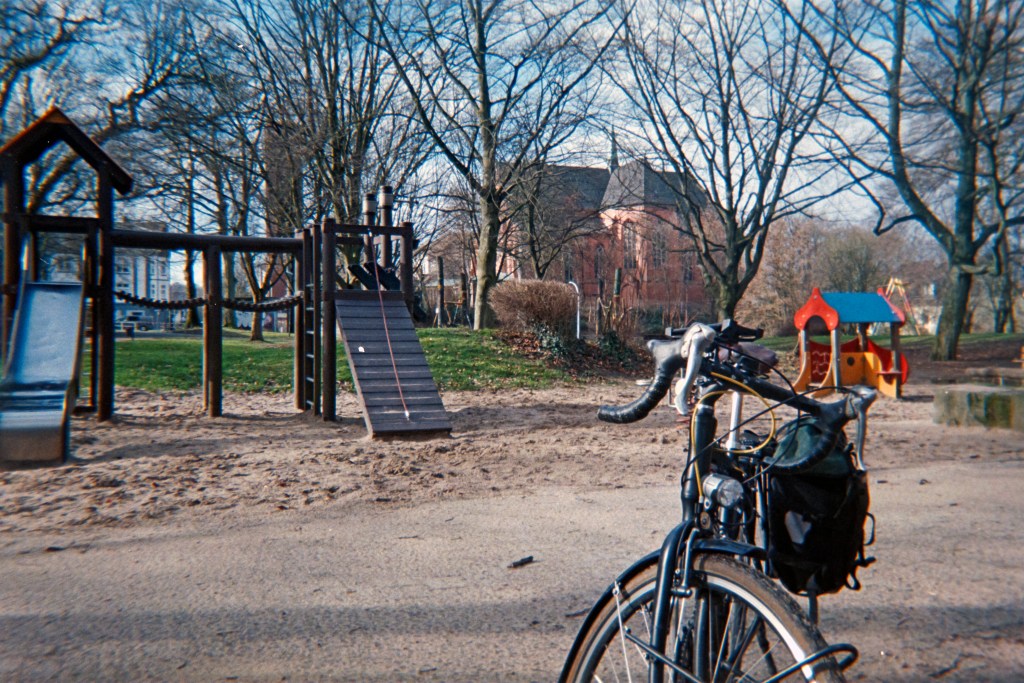
Gelsenkirchen, on the way to work, by bike. A playground, „somewhere in Essen“.
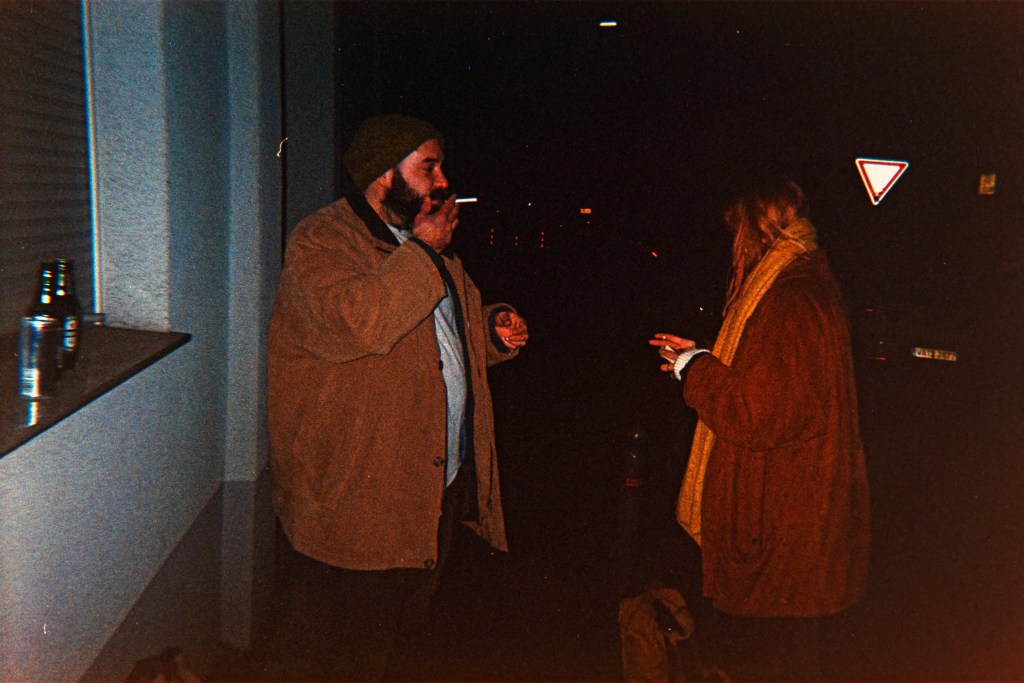
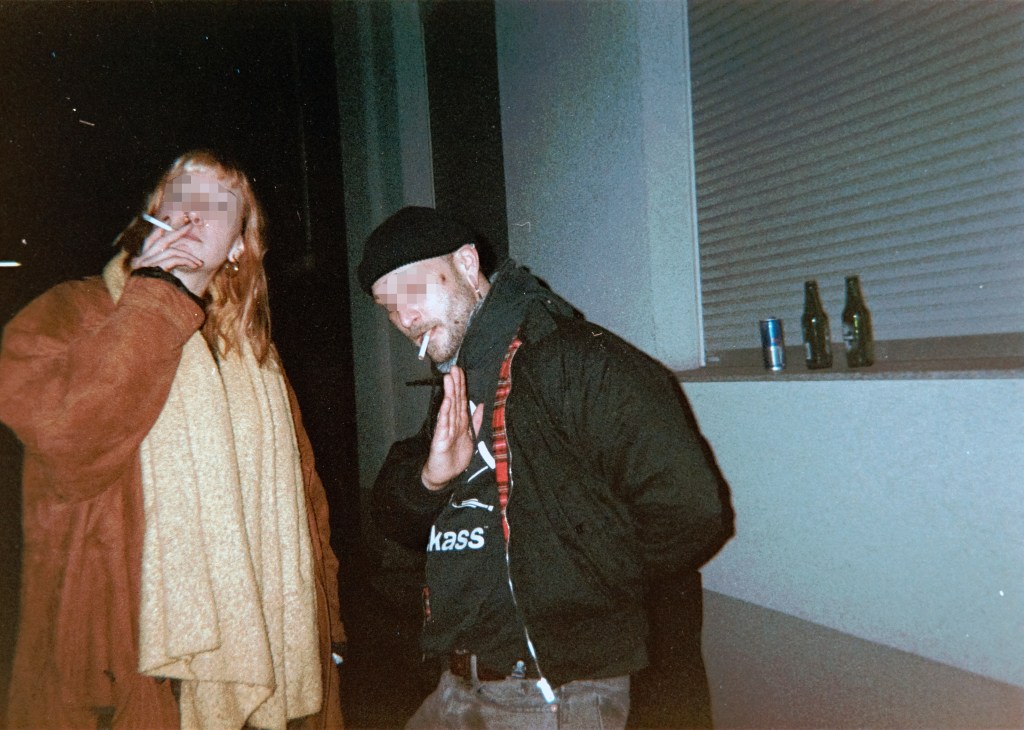
„That’s Boggi, that’s my buddy. In Wattenscheid, on the street, we had a drink.“
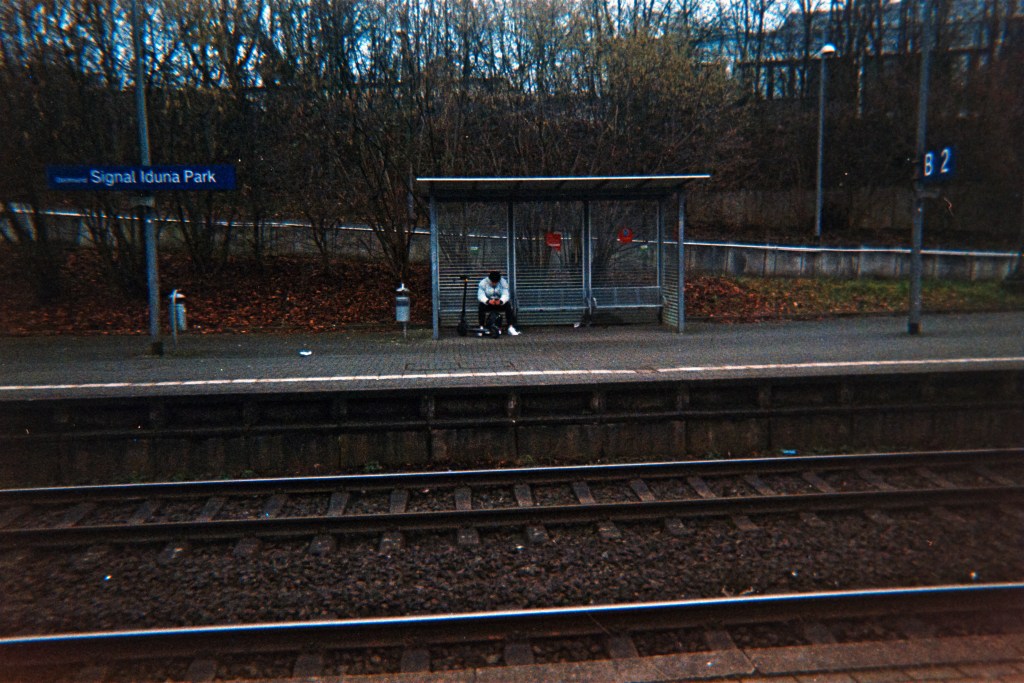
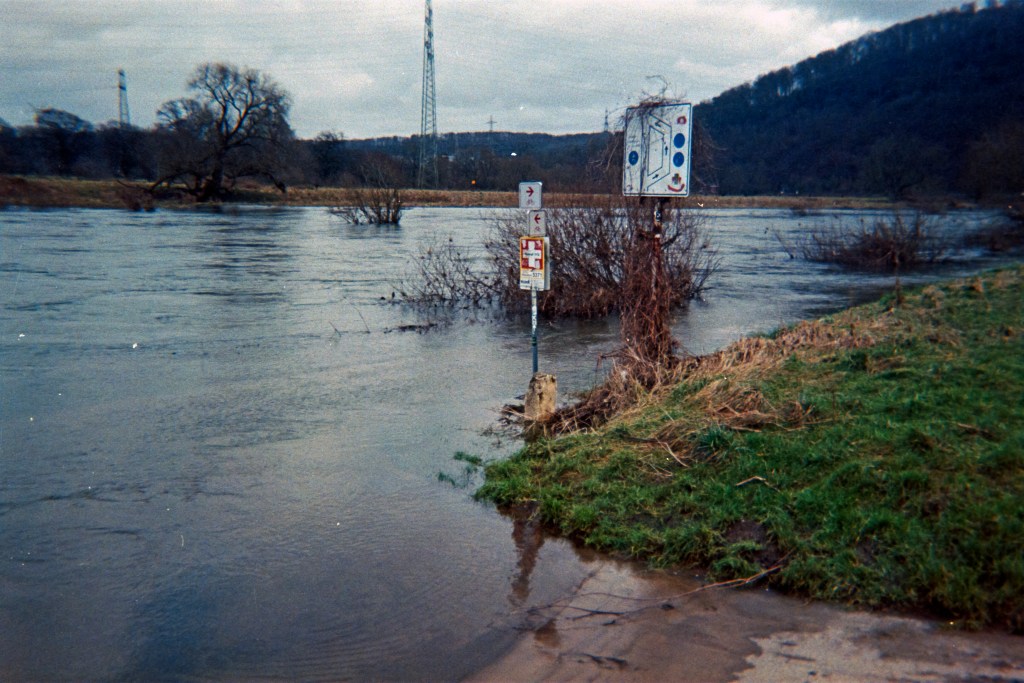
Dortmund, work. The city of Wattenscheid. „My bicycle in the wild.“ The Ruhr, flooded; the water reaches far into the fields.
Not all the pictures got developed, some are missing. „Too bad, I took pictures of my table and everything. A few party pictures.“ – „You want to describe the table to me?“, I laugh. „Yes, the table was full of various … stimulants, and beer and cigarettes.“ He speaks hesitantly and grins. „I guess we can talk about drugs, that’s okay,“ I say. We laugh. „Okay. Well, maybe there were drugs on there too.“ I ask Philip how he consumes. „All over the place. And preferably a lot. Because it simply makes me feel good. Drugs are like the state of consciousness of being off work, having a holiday. It’s just nice. I use regularly, irregularly, I’d say. I always have a break every now and then. Sometimes I don’t pay attention. And then I notice it. It’s like a real withdrawal. Really a week of being so mega tired and stuff. But otherwise it’s actually quite good, if you go through a day like that in a week, then it fits quite well, you can handle it quite well.“ I ask him for how long he has been using. „Since I’ve been in Bochum. Before that, yes, but maybe three, four, five times a year. Since I’ve been in Bochum, I’ve become a consumer.“ – „And why?“ – „Because my friends all do drugs here. They’re all drug junkies.“ He laughs. Currently, the drugs fit quite well into his life, they’re not a problem. „I just sometimes worry if the phases of being down – or becoming unproductive – are somehow linked to it.“ He’s not sure. „I look at drugs positively. To reflect myself positively as well. How was I before, how am I now? What are you missing to be Philip again and feel alive? I found all that through drugs. And I just like doing it. But I also fully understand that I have a circle of sober friends and they know that I take drugs, but they don’t think it’s good. But that’s also a perspective that I find good, because it’s not something that I necessarily” – he falters. „Well, I want to do it all my life, do a bit of ketamine or something and smoke a joint or whatever. Or psychedelic trips like that – sure, if it fits. There has to be room for it and it has to feel good. So I say ‚yes‘ to that, but I also understand the ’no‘.“ He appreciates the sober circle of friends very much, „because it’s sober ground contact. That’s why I have sober phases.“
During our last meeting, Philipp had told me that he imagines a different lifestyle when he thinks about the future and family planning. I ask him about it. „I think I would be much healthier to myself, because then I would also be healthier to other people. And it just starts with cooking by yourself. For me, the final stage isn’t a shared flat – so I think that’s nice too, and I would do that when I’m in a new city, because I’m happy like that. But when other people live with you, you just eat healthier and then you prefer to do that and then you cook better and nicer and shop smarter and like going to work better. That’s just kind of the final stage for me. I think that family is a kind of passion for me. And that’s why I think it would be much, much, much healthier.“ Is it okay the way it is right now? Or does it feel incomplete, I ask him. „Feels okay, yeah. I really feel like I’m 30, I’m 31. But feel like 30, because I’m young at heart.“ He laughs.
We talk about Philipp’s own family and also about how he experienced the topic of work with his parents, who are both health workers. „Yes, I am a working-class child. My parents worked a lot. But then they also had holidays and so on – we always went on bike trips – so we could also have leisure time at weekends and so on. And that fitted in well. But my parents worked a lot for little money, in the end.“ I ask him if he can talk to his parents about his thoughts on the social system and work. „Unfortunately, not at all. I have other parents for that, though. Second family.“ His „second family“, that is a childhood friend and his parents. Would he wish he could have such conversations with his own parents, I ask him. „Yes! Yes, but unfortunately you have to accept that you can’t. Well, I used to think that with a lot of thoughts, but they’ve gotten there in the meantime, that’s why: Never give up! I would have liked to, I would have liked to have had more backup from my family than there was. I was thinking that they could help more considering the lawsuit and stuff.“ He talks about his uncle, who is very influential and wealthy. „And then I thought that together with him I could just hack away at the social system. Change it in the blink of an eye. Like magic, right?“ We laugh. „But all I got from him was: ‚Yo, you need to chill yourself!’“ I ask what his parents said about the lawsuit, if they understood why he wanted to do it. „I actually don’t know if they understood. Well, they understand the basics of it, but they never wanted to do it, they always advised against it because they are such security-minded people.“ But Philipp finds support among his friends. A friend advises him: „Only do it when you feel ready. When you’re healthy again, then go for them.“
How is he feeling right now, I ask. How are things going for him? „Right now, they’re at a bit of a standstill. But before that they were going uphill. And now I hope that we are on a constant high right now.“ I ask Philipp about his plans. „My plans, both professionally and privately, are to have a lot of contact in the world again with different people, to work on joint projects. That the organisation gets going. That young people simply have a say in the political system, that the whole thing is set up transparently. That we also do political work, but also a lot of social and educational work, so that younger generations – I’m also witnessing this live at the moment and have also noticed it in my work at the foundation – that people at that age simply no longer know about any vocation or anything like that, or feel called. And that’s just a huge problem. Because this feeling of being called is one of the things that I say I’m missing at the moment and that simply robs me of a lot of vitality. Because you have to feel somehow called to do something so that it makes sense and is authentic. And I’m really afraid that people will become some kind of machines. Just work in some industry and then get out and then have a family and then go home. It’s totally crazy, robot is the Russian word for work.“
And right now, very specifically, what does he wish for now? He thinks for a moment. „I would have wished that the business, as I have already built it up in my mind, would already exist and that I could just lose myself in it, in the work, and no longer have to concern myself with the financial part of the work. But just with the work itself.“ Again, we talk about work, about financial worries and financial appreciation. „Well, I’d like to be rich too, but I already feel rich. I think it’s more important to feel rich than to be rich. For me, being rich is being able to have a beer and chill out in the sun at noon. And I can afford at least the little things in life. You don’t always have to go out to eat in a restaurant. But when I can afford to have a drink in the DB Lounge – that’s really cool. That’s when you’ve made it, you know?“ We laugh and enjoy the last rays of sunshine of the day.
 Projekt "Perspektive(n) Mensch"
Hinterlasse einen Kommentar