I get to know Yehia through Firas. Firas was Yehia’s teacher. I came across him through an offer in the neighbourhood: „Sign language course with Firas“. I try to get his contact details and ask him if we can meet. A week later we sit opposite each other. I ask him about the offer, what exactly it is and how it came about. The course no longer exists, he tells me, demand was too low. Firas is a teacher who taught in his home country Syria for twelve years before coming to Germany. He is the father of two teenage sons; both are deaf. Since Firas has been in Germany, he has been teaching sign language here. He tries to support especially Arabic-speaking families who have deaf children or relatives; hence the free offer that brought him to my attention. I tell him about the project I am working on and ask if he knows of any families who might be interested in participating. A few days later he calls me and tells me about Yehia. Firas was a teacher at Yehia’s school before he changed jobs. He suggests an appointment for me to meet Yehia and his family, where he accompanies me to translate into sign language for me.
Yehia’s father opens the door for us and leads us into the living room. Yehia is sitting on the edge of the couch, his younger siblings are romping around the flat. Firas greets him in sign. He answers him and smiles shyly. I tell him about the project, Firas translates, and we ask if he would like to join. Yehia nods. I show him the camera. He examines it curiously, looks through the viewfinder and smiles a big grin.
The next time we meet, Yehia and his family live in another flat, in another part of town. The father picks Firas and me up at the front door, smiling, and leads us into the living room. He points with his hand to the couch; we sit down next to Yehia, who sits on the edge of the couch as he did at the two meetings before. His parents sit opposite of us on the carpet; his little siblings play between the adults and their brother. I ask Yehia if we should look at the photos together. He grins shyly and nods.
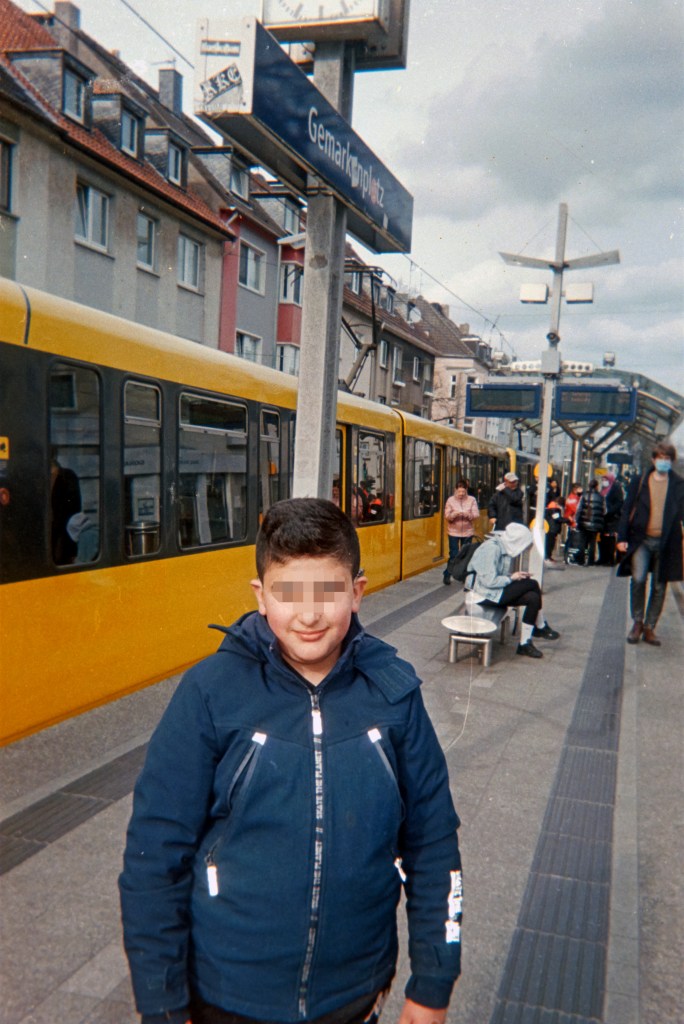
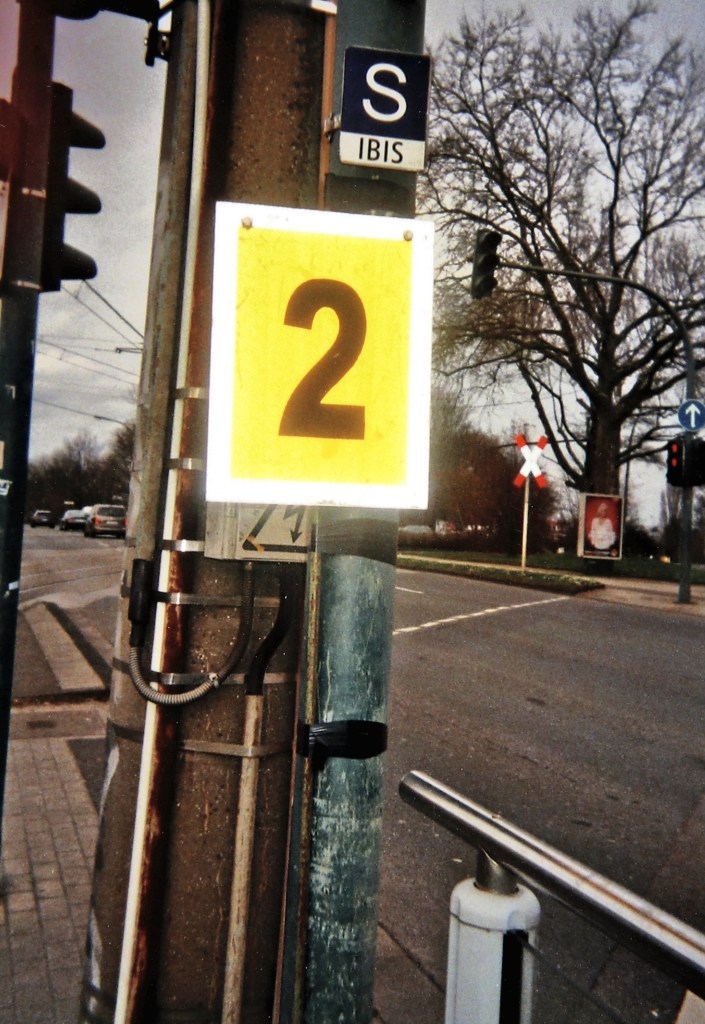
The first picture shows Yehia at the tram station near his old home. He shows the sign for tram. „We were on our way to Yehia’s aunt’s house,“ his mum adds. „Do you like riding the tram?“, I ask. „Yes, even more than the train.“ When Firas asks him what the number of the tram is on which he was in the picture, he knows the answer without hesitation and signs to Firas.
„He speaks private language more than German sign language,“ Firas tells me, frowning slightly. At school, Yehia learns sign language and spoken language as well as the written word. When he communicates with his family, however, he often communicates using gestures and signs that he and his family make up themselves to describe things. At our first two meetings, Yehia was completely silent, now he keeps making noises, trying to articulate himself. „This is not Arabic, English, German and not Kurdish. We don’t understand what he is saying. But he’s trying to talk a little bit. That’s great!“ explains Firas. Yehia’s mother adds: „The teacher said: ‚I have a surprise for you. Yehia is starting to talk! ‚ That was a week before the Easter holidays.“ Before his surgery, Yehia didn’t speak at all. It was in fact two surgeries: the first one in 2019, the second one a year or two later. The cochlear implant he received is made up of several parts located inside his ear, inside the skull bone under the skin and outside the body on the scalp. Yehia has been deaf since birth. Without the hearing aids it is bad, with them it is good, he tells me. The scars behind his ear are clearly visible. „Does it hurt?“, I ask. He nods. „The hearing aids bug him,“ his mother says. „The operation was bad for him,“ she continues, „he hates injections. „
The procedure should have taken place earlier, Firas explains to me, ideally at the age of one or two. The older the person is when the transplant is done, the lower chances are that it makes a difference. Still, you see a lot of progress with Yehia and the family is positive. „It takes time,“ says Firas. Firas‘ sons also had the operation late; both were already older than ten. „In Syria, the surgery is very, very expensive. “ Firas explains, the surgery costs more per ear than his house in Syria. „And that’s for one side! For one side, for one child, not for two children.“
Yehia was six when the family came to Germany. I ask him what it was like for him in his home country Syria. His mother tells me: „Since he was born, Yehia was always sick, he didn’t eat, he was very thin, he hardly played with other children. Many people said he was a stupid child, that he was disabled and so on. Here in Germany, he eats and drinks well, here he is healthy.“ I ask him where he liked it better, in Syria or in Germany. Without hesitation, he signs Germany.
Through the operation and with the devices, he can hear something. For example, when his parents call him loudly from another room, he hears and recognises his name. He used to hit his siblings and was often violent when playing. This has improved since he can hear and communicate verbally. He communicates with his siblings in his own sign language, they show each other what they want to communicate.
In general, however, Yehia is very cautious and reserved with people. I ask him if he has any deaf friends. He nods, but his parents deny it. He has no friends, they say, and he only sees his classmates at school. His mother says that Yehia has a lot of problems with strangers, whether they are children or adults. After some time, when he has seen them more often, it works, but at the beginning he is very shy. However, Yehia likes his teacher and the other children in his school very much. „Yes, I noticed that, yes!“ affirms Firas, who has taught there himself. I ask why they don’t meet outside school. „Maybe it’s a bit the families, they would have to organise it,“ Firas explains. He tells me that Yehia’s teacher regularly offers meetings where the children play together, and the parents can exchange ideas. Unfortunately, the demand is not that great. But Yehia is in contact with his classmates via Whatsapp and video calls, the parents say. I ask if he has other friends, perhaps non-deaf children. „No, only at school,“ his parents explain. They have hardly any acquaintances in the city, few points of contact, they say. They hope that the children will have more contact with the neighbouring children here in the new house and the surrounding area.
Yehia’s mother continues and tells me that he is afraid when he is outside alone, especially on big roads, because he cannot hear what is going on around him. A family friend tries to be a little supportive, goes out with him and shows him what to look out for and how to find his way. When his parents are around, Yehia is not afraid. The family usually goes out together, whether shopping, talking a walk or going to the playground. If there is a person with him whom he trusts and who gives him some orientation – „he knows: it’s red, it’s green, he’s allowed to do that, he’s not allowed to do that“ – everything is great, his parents say.
The mother tells me that Yehia’s teacher keeps telling the family that his behaviour at school is great. At home, however, he is a bit difficult. Sometimes he breaks things or hits his siblings. The parents do not understand how this discrepancy comes about. Is the teacher perhaps whitewashing his behaviour at school or not seeing it? Or does he really only behave like this at home? We talk about the fact that Yehia can communicate with the other children and teachers at school. At home he can’t. At school, his situation is the same as that of the other children. At home it is not. This frustrates him. I ask his parents if they understand him when he communicates in signs and sounds. They ponder. „About half, a little more,“ the father says. „At home we understand about 70 per cent of what Yehia communicates to us,“ says the mother. „It’s a bit difficult when Yehia comes home from school and he has learned new words or signs.“ Firas advises the parents to look directly at the new signs in his notebook every time he comes out of school and learn them along with him. The mother says that the two of them wanted to take a sign language course. However, the health insurance and the youth welfare office refused to cover the costs because of their residence status, the Duldung. Yehia’s teacher had offered to teach the parents one hour a week at school. However, due to the pandemic, the offer could not take place. The parents speak to Firas in Arabic, the father rubs his face dejectedly. „Patience, patience,“ Firas says gently.
Together with Yehia, I continue to leaf through the photos.

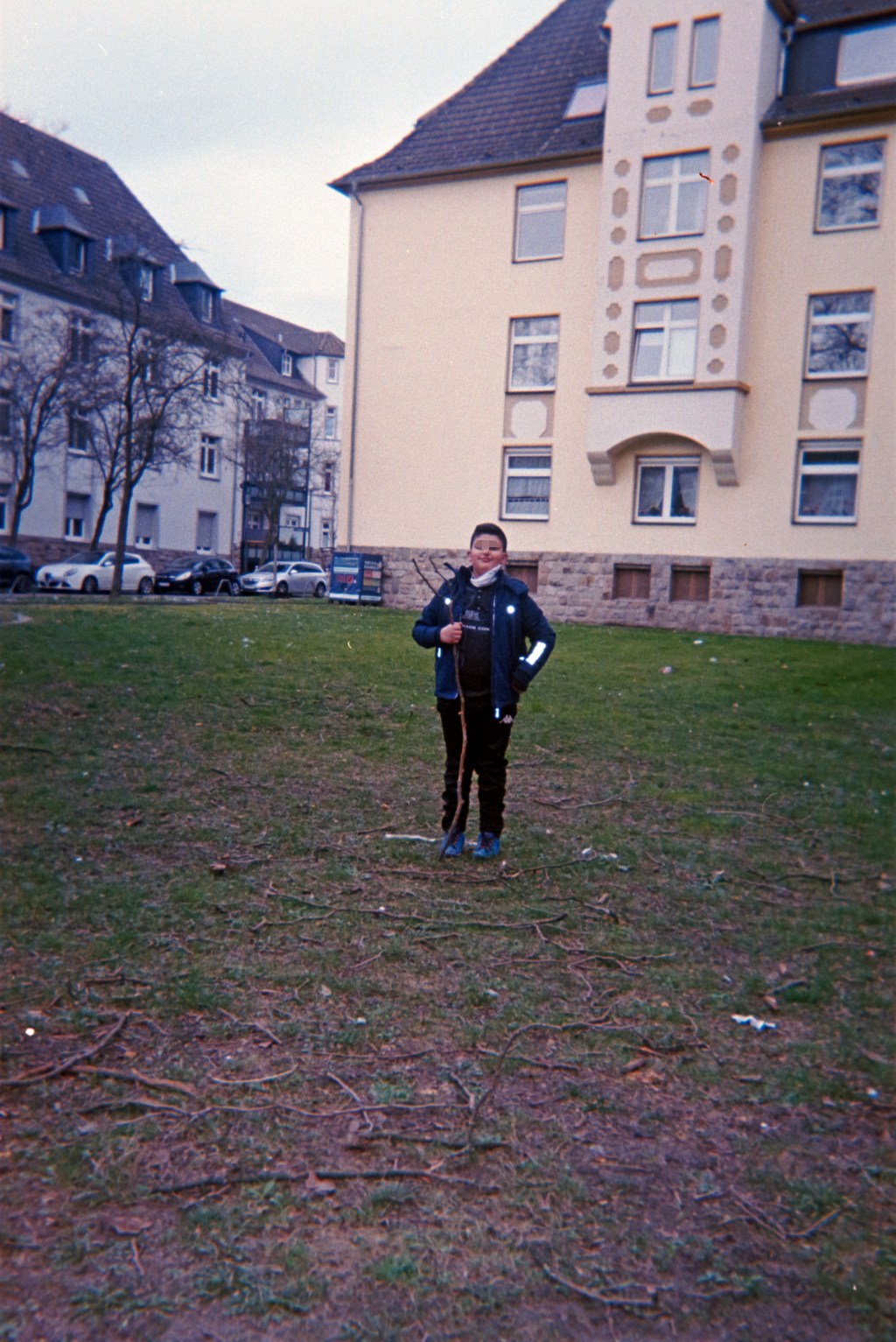
The next picture shows him with a big branch. He mimics the photo and shows me how he proudly holds the branch like a scepter in front of his chest sticking out. „You look like a king,“ I say. Firas makes the sign for king, Yehia laughs.

The next picture shows Yehia at his aunt’s house playing with his cousin. His father took the photo. Yehia is upset, gesticulating wildly. He didn’t like the fact that his baba just took the camera away and took a picture without asking him, he tells us. „Next time Baba takes the camera away from you, tell me,“ Firas says to him. We laugh, Yehia rejoices triumphantly. The boy he is playing with in the photo is his cousin and is called Malek. Firas asks Yehia if he can spell the name with the finger alphabet. Then he speaks the two syllables to him one by one, loud and clear. Yehia tries again and again to say the syllables in phonetic language until he succeeds. Everyone is happy, his parents clap their hands. Firas encourages him to say his own name in spoken language. Again, he succeeds and beams when he sees his parents‘ enthusiastic reaction. Firas tries to repeat Malek’s name again together with Yehia. He claps his hands underlining the syllables: „Ma-lek“. Again Yehia tries to mimic the sounds: „Ba-ba“ – „Not Baba,“ says his mama. „Yehia! „, she calls him and gets his attention. „Mh, mh,“ she makes the sound for him again and again. He tries but doesn’t get the sound. „He still has to practise a bit,“ she says with a laugh. He learns a lot at school. Firas explains: „Malek, for example. First they hear, then comes the writing, and then they spell with sign, and then the sound.“
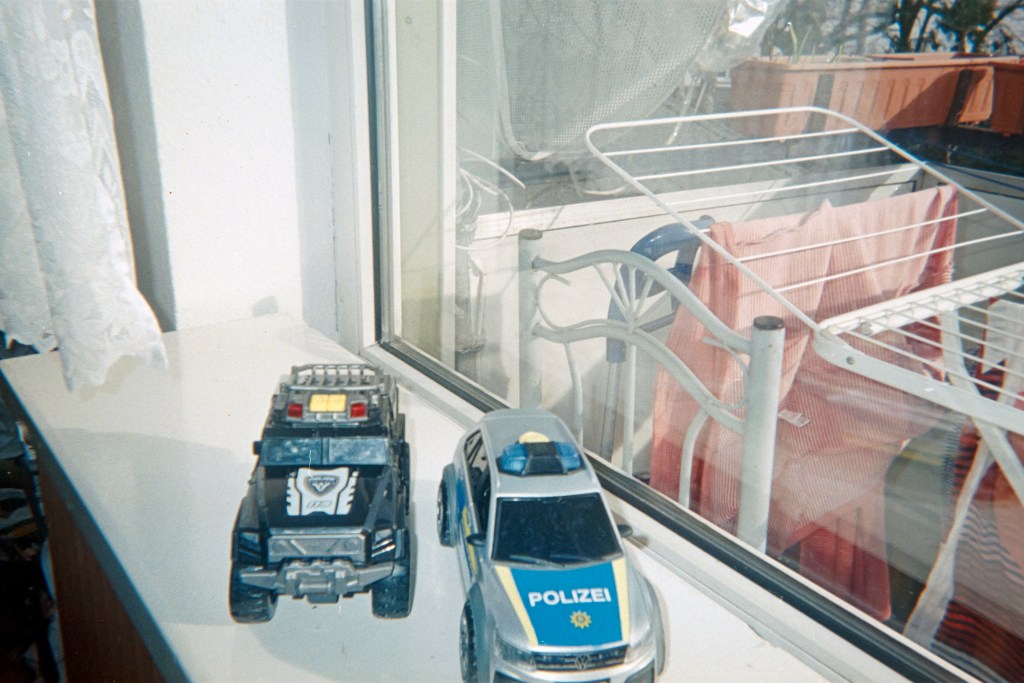
We continue looking through the pictures. The next photo shows toy cars. I ask Yehia which one he likes best. He shows me. He also likes excavators. And what is his favourite toy, I ask. He likes his Rubik’s Cube best, and building blocks. A friend of his father’s has a PlayStation, sometimes they visit him and Yehia is allowed to play on the Playstation. His father looks over at him, spreads the fingers on both hands, shows the number ten with them and sticks out his tongue. Yehia shakes his head vigorously and shows the number seven with his hands. „What do you mean by that?“, I ask. The father explains that Yehia is a big fan of Cristiano Ronaldo, with the number seven. To tease him, his father shows him ten, Lionel Messi’s shirt number.

The next photo was taken by Yehia in the childrens’ room, of the bunk bed where he and his sister sleep. She is climbing on the lower bed. „He doesn’t want to sleep on top, only on the bottom. He is afraid,“ his mother tells us.

The next photo shows Yehia with his siblings and a neighbour girl. She is the same age as one of his sisters and sometimes comes over to play. The next photo he took shows the food in front of him on the plate: tomatoes, cucumber, salad. What does he like to eat best? Pizza. He also likes salad and pasta. And sweets, he says now. Rice pudding. „He eats two plates of it,“ his mum says with a laugh.

In the next picture, Yehia is standing in front of a car. His father tells us that Yehia liked the car and asked him if he could take a picture of him in front of it. „Yehia told me to buy the car. I guess the job centre and social welfare office see that a bit differently,“ he says and laughs. At our previous meetings, Yehia’s father had already told me more about the family’s situation. All family members have a Duldung, although they fled the war in Syria. The father was first registered in Europe in the Baltic States, not in Germany. Theoretically, he and the family are threatened with deportation there. That would be fatal. Yehia’s two youngest siblings were born in Germany. Yehia has a genetic defect, needs access to medical treatment and aids, to special support and education, which he could get neither in Syria nor in the country where his father was first registered. Nevertheless: the family receives no residence permit, no clarity, no progress. During the recent appointment at the immigration office, the father now tells us, the employee said he has to present Syrian passports for him and the family. He explains that he can’t just get them at the Syrian embassy. You have to get them, says the employee at the Foreigners‘ Registration Office. Will we be deported, the father asks him. The employee does not know; the BAMF decides. Yehia’s father tells us that he has friends and acquaintances in other federal states and cities who came to Germany on the same terms as he did and who by now all have a residence permits. Each immigration office acts differently in its discretionary powers. The immigration office in Essen is known not to use theirs to the full. But they won’t let him move to another city either. He does not get a work permit either. He can work, he wants to work, he says. „I can drive a truck, for example.“ I ask him what he did in Syria. He had his own haulage company, he tells me, which he had taken over from his father. „Nina, you know, 70% of the Syrian asylum seekers who came to Germany had their own houses, offices or companies or or in Syria. But now …“, Firas falters. „Now Syria is divided: the president’s part and Russia, the Kurdish part with America, the president’s opponents with Turkey and ISIS. Even if I chose one part, I would be scared everywhere! All four parts suck – sorry!“ Firas and Yehia’s father describe the current situation in Syria to me, talk of violence, corruption, hostage-taking. They switch to Arabic, I hear Firas becoming emotional and his voice louder for the first time.
A Syrian passport usually costs 300€, faster processing 800€, Yehia’s father tells us. For the whole family, they would face costs of two or three thousand euros. Yehia and his sister need a Syrian birth certificate, each for 550€. „And everything is under the table, there is no other way.“ The father says he doesn’t want to pay this money, doesn’t want to give money to Bashar Assad – „And Assad buys weapons with it.“
By now Yehia is getting a little restless. He gets up, fetches a scooter from an adjoining room. He wants to play. I get a data protection declaration out of my backpack and explain it to the parents, they have to sign. The father, without hesitation, points to his wife: „She’s the boss!“ She signs the form, grinning. I thank Yehia and ask him if he wants prints of the photos. His mother says he already has so many photos, all of them would be too many, but he is allowed to choose some. He looks through the photos and finally holds out his selection to me. Yehia in front of different trams, Yehia in front of a bunch of balloons in the old flat. In all the pictures: Yehia with the biggest grin.
 Projekt "Perspektive(n) Mensch"
Hinterlasse einen Kommentar