
I get to know X through a neighbourhood group: Russian-speaking people over sixty meet once a week in a building which belongs to AWO. The first time I am there, the half-hour dance gymnastics is just beginning, led by a student from the Folkwang University who also speaks Russian. „Would you like to join in?“ I am asked. I answer, „Sure!“ and find myself – slightly overwhelmed by the movements – in a circle of senior citizens who either smile benevolently at me or try to explain in a language I don’t understand what exactly I am supposed to be doing. After the dance gymnastics, everyone goes back to the room where they were sitting for breakfast, and I introduce myself and tell them about the project I am working on. Some of the visitors translate for each other, there is loud talk and discussion across the table, and I ask the group if anyone would like to participate. The discussions and conversations continue and while I look searchingly into the faces, the woman to my left says, „I’ll do it. I can do it.“
A few weeks later I meet X again in the same building. While the others go to have breakfast together, the two of us sit down in the hallway by the entrance. Every now and then the door opens briefly and someone walks past us through the room towards the restroom. I start my recorder and ask X if everything has worked out so far, if she found it easy to take the photos. She thinks for a moment and tells me that she wasn’t exactly sure what to take pictures of in the first place. „I wanted to show something special, of course, but in life there isn’t something special every day.“ I take out the pictures.
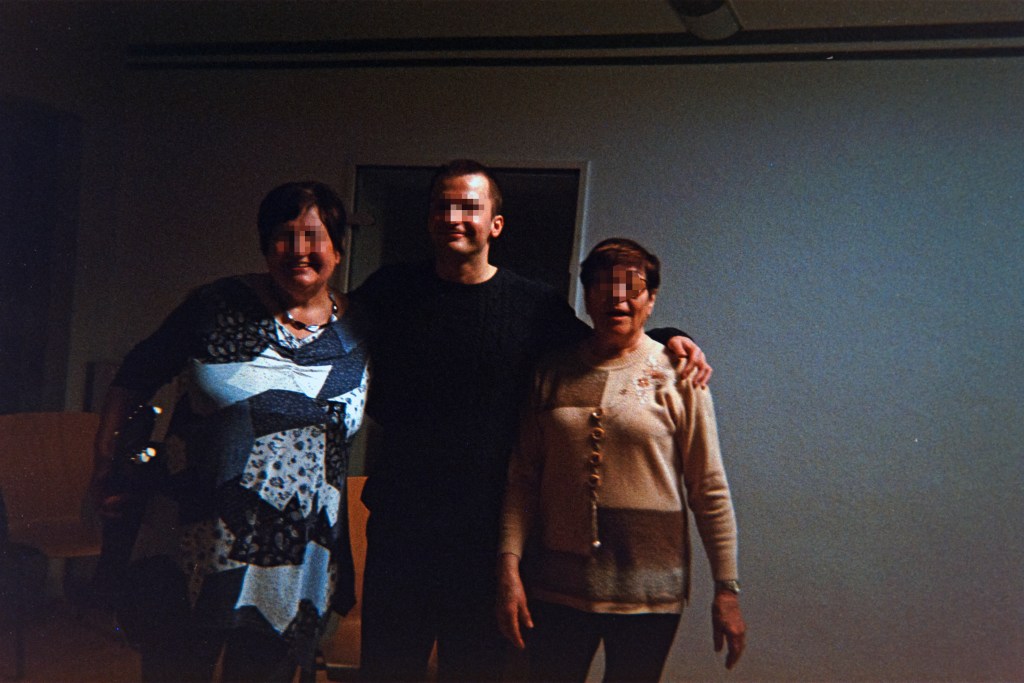
The first photo was taken in the room where we are now sitting. „This is our dance teacher and the girls, this is our group.“ I ask her since when she has been coming here. She has been with the group for about four years; she did not know the other visitors before. „I typed in AWO on the internet and got telephone numbers and checked them out. There were also German groups, but they turned me down right away.“ She laughs. „But that’s not bad,“ she adds quickly. Since she had only ever spoken German in her family, she first thought it would be good to look for a German-speaking senior group. „But now I’m really happy that I ended up here. And I also live very close to here. That’s why it all worked out quite well.“ Her partner is German; the only language they speak together is German. Her son, who is now grown up, doesn’t speak Russian either. „Did you never want him to learn Russian or was he not interested?“, I ask. „My husband wasn’t interested,“ she says with a laugh, adding, „I’m actually German, Russian-German.“
She came to Germany 28 years ago as a Spätaussiedlerin [ethnic German immigrants from Eastern Europe and the former Soviet Union]. She grew up in a town in Siberia, speaking only Russian at home at that time. „I never met a German person in my whole youth.“ The family has to wait almost four years for their application to be processed before they can emigrate to Germany. During this time, X already begins to learn German. „Vocabulary I already had a little bit in Russia and from the beginning understanding was not so difficult, but expressing yourself properly – until now!“, she laughs. „That’s perfect like that!“, I counter. „Perfect I don’t know, but anyone can understand me if they want to.“ What is it like for her to speak her mother tongue, to speak Russian, I ask. How does it feel? She ponders and finds it hard to find the right words. „I can’t do it, only Russian all the time, I can’t do it,“ she finally says. „I don’t want either of them as the only language. I’m happy to come here and be like this, but only like this… I don’t want that.“


I continue to browse through the photos. The next pictures show the skydiving hall in Bottrop, an indoor parachute simulation. Friends of hers gave her a voucher for her birthday. „It’s really unique, really great,“ she says enthusiastically. There is also an indoor ski slope nearby, she says. She would also like to go there one day. „I grew up in Siberia. Skiing is a must there, so to speak,“ she says with a laugh. The city she comes from has almost one million inhabitants and is located by one of the largest rivers in the world. She grew up there with her parents and her brother, who now lives in Mülheim. Her father had already died before the family left for Germany. Almost every Sunday she cycles the 15 kilometres along the Ruhr to her brother’s house. They meet outside and go for walks. He has two grandchildren and one great-grandchild.

The next photo shows X with her brother’s great-grandson and with her boyfriend; the great-grandson will soon be two.
I ask her about her own son. He will be 26 this year, goes to university and lives in Dortmund. I ask if they see each other often. „Not often, unfortunately.“ She pauses. „My husband, his father, died. And he wants to be alone.“ – „I’m sorry to hear that,“ I say quietly. „It’s been six years, and yet it all hurts so much.“ She has been with her current partner for four years; they live together here in the neighbourhood.
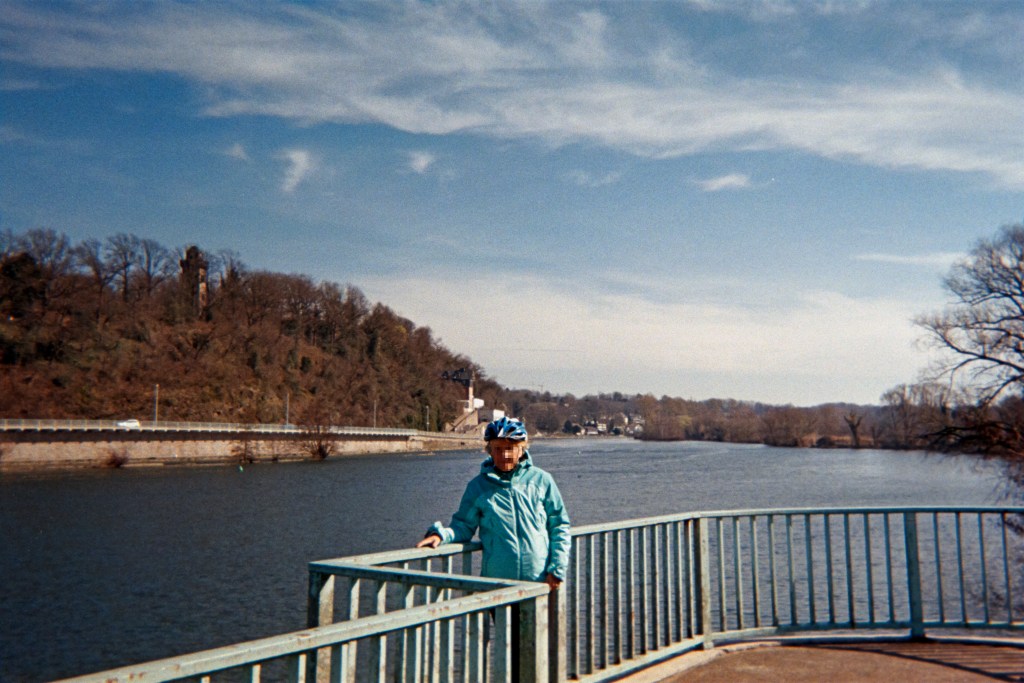
We come back to the photo and talk about cycling and her e-bike. In town she always rides without the electric support, she says, only when she goes to her brother’s, she turns on the motor. I ask if she has always done a lot of sport. „I’ve never done any specifically. Although I had a car and a driving licence, I used a bicycle almost all the time in Germany. If I didn’t have to take my mother or my son somewhere by car, I always cycled. We were in a small town at the time, so it was more convenient for me to cycle.“ At that time, they lived in a small town on the edge of Sauerland: 30,000 inhabitants, roughly half an hour from Dortmund. I ask how and where she met her husband. When she arrived in Germany, she was in Chemnitz first, where she had her language course and accomodation. She was 38 at the time. „Then I met my husband, through a newspaper ad, and he brought me here.“ It all happened very quickly, two years after she came to Germany, they already had a child.
In the new city, she had two friends in particular, a German woman and a Russian-German one. She laughs. „With my German friend we went running once a week. We call it running, but it was like this,“ she makes a chattering motion with her hand, signalling that it was actually more about chatting than running. „We walked together for a couple of hours in nature. And I’ve been in touch with her until now.“ They write regularly on Whatsapp. „And my fellow countrywoman … she is so against Putin and since I told her my opinion, she doesn’t write me anymore. Maybe I need to give her time.“ She is silent for a moment. I ask her if she misses the town sometimes. „No, it’s quite a small town and I grew up in a city with millions of inhabitants where there were theatres and stuff. And this small town … when my child was little and I was busy, that was okay. But when he was grown up, this city had already been a bit too oppressive for me. That time and with everything that happened to me, so I’m glad I’m gone.“ Her husband died there, in the small town where they had lived together. She only came to Essen after his death, when she moved in with her new partner. I ask if her husband had been ill. „Actually … not really. It was a bit sudden. I didn’t think it could happen so quickly.“ At that time, the son was still living with them, just finishing school. X speaks more and more slowly and quietly now, so that I can hardly understand her. Not only did she lose her husband during this time, but also her mother, she continues. Her mother lived in the same house, in a different flat. „For me, that was a very big help. She did everything for me, everything.“ Again, she becomes silent.
After her husband’s death, her son starts studying in Dortmund and moves there. „I wished he would come to Essen to live with us, but …“ she laughs softly. „Oh, that’s understandable actually. It’s stupid, keeping the child with you. And if it were both parents, but like this …“ I ask if her son gets along with her partner. „When I see him very rarely, they get on quite well.“ She laughs again.
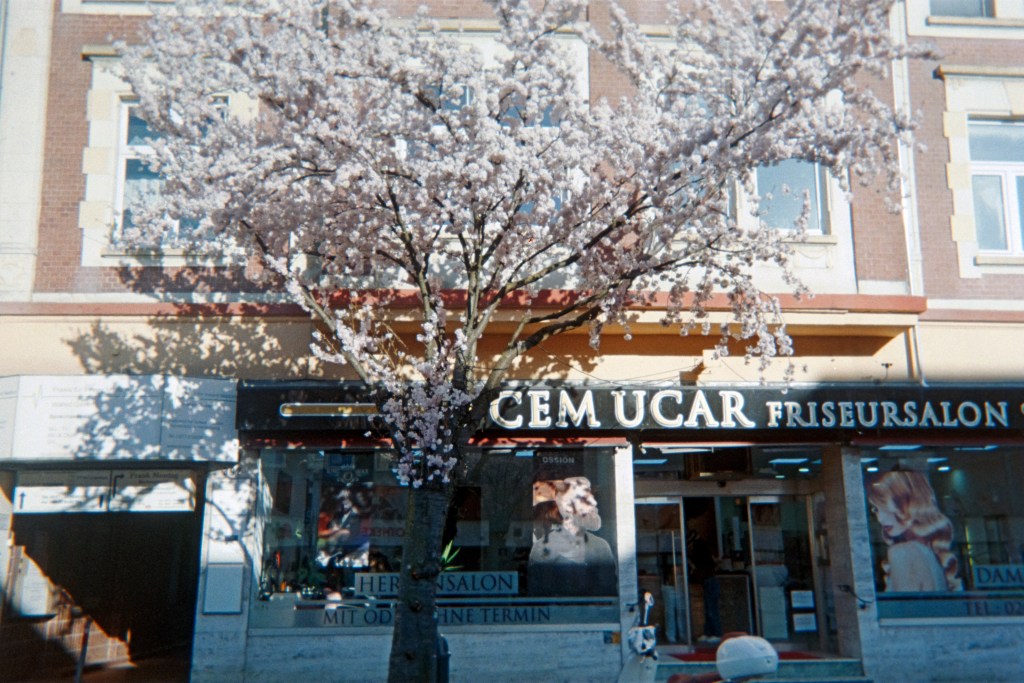
I put the next photo between us; it shows the cherry blossoms on Altenessener Straße. She likes to be outside, she tells me now. „I don’t like to stay in the flat. I can’t manage sitting in the flat all day. I have to get out, I have to get out. No matter what, just out. But that started after what happened with my husband.“ I ask her what he was like as a person. She’s thinking. „He’s also a lot about sports, he did all the sports with my son, taught him, took him there. He was the sporty type. A lot of cycling as well.“ – „Did you do that a lot together then too, cycling and things like that?“ – „Actually, he did more with the kid. It was too difficult for me. They ride really fast and I’m like a burden, then they can’t go on. That never worked out, actually.“
We talk some more about the time in the small town. „Did you also work or were you mostly at home with your son,“ I ask. „I worked a little, but not much. Mostly I was a housewife.“ She continues, „In Russia I worked in the tax office, but not here, of course. I was in an old people’s home, a few hours, as a housekeeper, but that’s …“ she laughs. I ask why she couldn’t continue working in her actual job here. „First: language. Then: the child, too. Having a child at that age and concentrating on the profession – I was already almost forty. Maybe with a lot of effort you can achieve something, but then you have to divert that effort from the child. One thing is falling short, child or profession. Especially at that age.“ I ask her if it’s okay like that for her or if she sometimes regrets it. „I tell myself, ‚It is the way it is.‘ Because those thoughts just make you sick. It’s all speculation: this, that, this. Of course, I push those thoughts away. I say to myself, ‚Why are you hurting yourself? It’s over anyway, it is the way it is. Try something NOW: live, bring, do, something.’“ – „I think that’s a good attitude,“ I say. „That’s looking for a solution for living on,“ she corrects me.
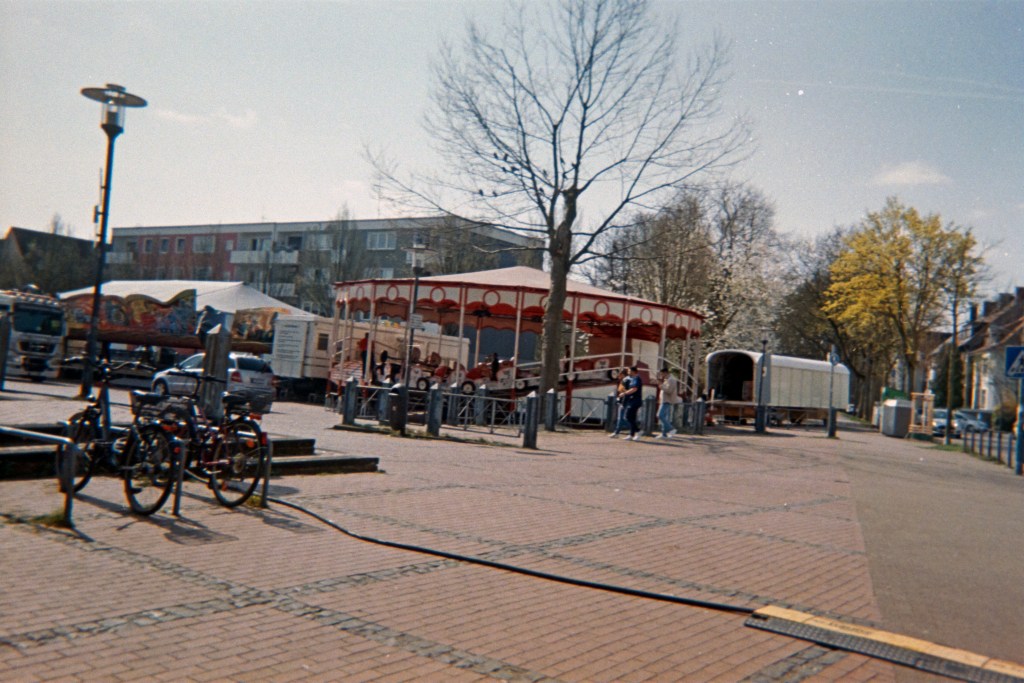
The next photo shows the yoga class she attends. „It’s great, AWO has a lot to offer: Yoga, dancing, choir.“ The next photo shows the „Kirmesplatz“ in the neighbourhood. „It’s actually quite nice, I think. In summer we even go dancing there. There’s live music even, on Friday nights.“ She attends many of these events and activities in the neighbourhood. I ask her how she likes it here in Altenessen. „I’m quite happy to have AWO here. It’s basically because of AWO, I like it here a lot.“ I ask if she does anything with the people from the senior group besides the weekly meetings. „Yes! Two years ago, in the summer, there was an offer for these train tickets, that you could travel for free in NRW. And most of the people in the group got that and we did something every weekend, every weekend! Cologne, Bonn, Münster. And then, for some time during the Corona period, we met more often in Steele and went for walks along the Ruhr, every week.“ They have also taken overnight trips lasting several days together. „It’s good that there are so many offers,“ I say. „Yes, that’s simply – for my situation, that’s my salvation. Because I can’t sit at home, walking on the street all the time is also a bit stupid. The main thing is to be with people. Talking to someone, doing something with someone. I have appointments here almost every day. And at home, sitting in a small flat …“ she doesn’t continue. „What’s it like when you’re alone? Do you have any negative thoughts then or anything?“ – „Yeah yeah, everything. Memories and stuff, it all comes up. It’s too much for me.“ – „Do you ever talk to people about that too?“ – „No, not about that at all. I couldn’t talk at all back then, I just cried. And when I talk, I start to cry, and I don’t want that. What for? For the others as well … We want, everyone wants – of course you ought to experience something beautiful, nothing sad.“ – „But it’s also part of life somehow.“ – „Yes, but do you have to bother others with it?“ – „I think people can stand it sometimes, can’t they?“ – „I cry, it doesn’t make other people happy either – so what’s the point?“ – „But maybe you feel better afterwards?“ – „I don’t know, I don’t know. I want to switch off, switch off. These never-ending thoughts. I even sometimes when I’m riding my bike – even though you’re not riding alone, you’re always like alone because you can’t talk. That’s why when I’m riding, I sing. To switch off from the thoughts, I sing. I already begin to feel it’s too much for me. These thoughts start, then I sing.“ I ask if she can talk to her boyfriend about it. „No, I don’t want to, either. Short and small things, but …“, again she talks so quietly that I can’t understand her anymore. I ask her how she met her partner. „Through ads, too.“ – „And what does he do,“ I ask further. „He still works a little. Still very little, lately. And then we go cycling together. And to the sauna we go. That’s our only – our life, that’s how it is: cycling and sauna.“
Again, the door opens. This time the social worker sticks her head through the open crack. „Will you be long?“ I answer that we are about to finish. The dance teacher is already waiting; the programme is about to continue.
 Projekt "Perspektive(n) Mensch"
Hinterlasse einen Kommentar