Florian and I have known each other for a few years. We met at a square in Essen. At a square, where I always meet him, where he always is. When I tell him about the project and ask if he would like to join, he is thrilled. A few weeks later we meet there again. He – as always, a bottle of beer in his hand, I – get one too and sit down with him. He tells me that he always has his camera with him and takes photos of all the people he meets here on the square. „This is the gang, the mafia of love!“ He would like to write a book, about the gang and their adventures. As always, he is bubbling with ideas and creativity.
Now we meet again to look at the developed photos I have with me together. This time, however, not on the square, it is still too early in the day, and he suggests another place. It is spring and warm, he is lying on one of the benches in the sun with his eyes closed, next to him a beer, in front of him on a wooden table two torn out pages of a map, folded up.
I sit down on the bench opposite him, he opens his eyes and sits up, I take the map and unfold it. The pages show central Italy. „Who in your family actually is from Italy? „I ask. He begins to tell me: „My surname would actually be Monte Leone. My dad was born in 1943 and his name is Alessandro PETER” – he laughs, „the second name was chosen by his mother in Essen. Because my grandfather, my father’s father, was an intellectual anti-fascist architect from Palermo in Sicily during the war. And he met the prettiest lady in Essen – my grandmother.“ Florian never met his grandfather in person. „My father never met him either, he never met his own father. Once very briefly.“ The turmoil of the war, the grandfather goes back to Italy. „He just had to, there was no other way. You know, he had his baby – my dad – who he really – totally sweet, he still wrote postcards from Italy, with such a bumpy German: ‚I miss my son, how is he? Where are you? Where are you?’ But then my father had the misfortune that his mother – I met her, my grandmother – was an unbelievable bitch, such a shrew. And his grandmother was even worse. So he grew up with his mother and his grandmother, without a father, and an only child. And that led to nothing but a kind of lostness, you know? In his roots.“ Florian’s connection to Italy is as strong as it is present. It is not only in his own origins that he feels connected to the country. „I have three children with an Italian woman. Of course, I didn’t type that into Google: ‚Would like to have three children with an Italian woman‘.“ He laughs. „It really just came about out of love.“ On the map between us, he shows me where she comes from, the mother of his three children, and his ex-wife. „You have to imagine, I played gigs here, we did puppet theatre, art projects, the Assisi Peace March – there!“ he energetically pounds on the map. „This is a cultural landscape, unbelievable! And by the way, they are so warm the people! And the food! And the wine! No?“ I already know his longing for Italy; we’ve talked about it many times before, about this urgent feeling to go there, to have to go there. „My grandpa is from Palermo! Piaggo Gino Monte Leone. That’s Sicily, the capital of Sicily. Do you know how many times I’ve been to Sicily? Not a single time. Unbelievable. I have direct blood relatives there who, of course, don’t know me. He won’t have told them about me.“ He tells me about how there was a time – at the dawn of the internet – when he was always googling and searching through the Palermo phone book: Monte Leone, his grandfather’s last name. He finds 70 people with that name. „What’s that? They’re all related to me! They must be! There’s no other way.“ A first name catches his eye, the same name that one of his daughters bears. „And then I really phoned at about 10 p.m. – I thought, now I’ll call them, just like that! And I didn’t speak Italian very well then. I called them in Palermo. And they answered. That’s totally crazy: the epigenetic – that is, the mapping of language inside oneself. I didn’t get to know my grandfather and my father speaks much worse Italian than I do and he’s also the type – he’s a German secondary school teacher, retired, semi-professional musician and is also a fine guy, but it skipped a generation and I swear that I’m just like my grandfather, but I never got to know him. There are a few photos that I saw and thought: ‘That’s me!’ He was one hundred percent exactly like me. I thought even as a child – I had absolutely no idea about the language and the culture. And I always understood everything, immediately. I grew up in Essen Werden and there were two Italian dancers walking past me and they were chattering away and I somehow understood everything intuitively, you know? And then I called them in Sicily and I didn’t know the language yet, I just said: ‚So!‘ And then I told them the story of my past. And then she said in the broadest Sicilian dialect – that’s a completely different language, it’s not Italian at all, it’s Sicilian. She said: ‚I’m really sorry about that. It’s really nice that you’re calling. Oh, you have a baby? A little daughter with the same name as me? And your grandfather – but I certainly didn’t know him.‘ And she spoke to me in Sicilian, but I understood everything.“
We talk about how things are passed on, sometimes through generation and sometimes subconsciously: language, experiences, feelings, traumas. „As survival animals, humans don’t notice the acute,“ says Florian. „If I hit your head with a bottle of beer, you’d think: ‚What the fuck was that?‘ And then you’d block out the pain, just to survive. But the day after tomorrow you’d think: ‚Wow! What the hell was that?’ That is the post-traumatic, that all comes later.“ His grandparents and parents, who were shaped by war, people who are currently fleeing from Ukraine or from one of the many other conflicts and wars currently raging in the world – he sees parallels in all of this: Horrors that are deep inside of us, that we sometimes encounter again much later and that are often passed on and thus also become the horror of others. But Florian is sure that – no matter what we have been handed down from other generations – we are responsible for our own actions. „My father, that fool, always said – which I never understood at all, that contradicts every basis of my philosophical cohesion. He asked to talk to me one day and said: ‚Look, if I’ve done things wrong towards you, you must understand. I didn’t have a father myself!‘ Of course, he had a father, otherwise he wouldn’t be there, but he didn’t get to know him, not consciously. And I had to think about it. The explanation for fascism and Putin and whatever is not that his mum was somehow stupid, you know? So it’s not an explanation for the bad or the good, is it?“ – „Yes,“ I agree with him, „I think you push away a bit of the responsibility.“ – „That’s it! Exactly that!“
He himself has two siblings. Both have cut off contact with their parents. „Both of them had some kind of trauma, which of course had to be dealt with through such – nowadays, you know? I think they both went to therapy, but I don’t know exactly. ‘I think I’m so unhappy in my life because of my childhood‘ – in cliché terms. And me, well, I don’t know either. I probably always had more resilience, or whatever the fuck they call it. I always thought: ‚Yeah, that’s just my parents, it’s not their fault. But that’s still your own life. And now you have to make the best of it.’ Crazy enough, they’re both childless. So I’m the only one who gifted my parents grandchildren.“ He drags out the „gifted“, laughs and takes a sip of beer.
Again and again, he finds himself between his parents and his siblings, expected to give answers that he himself does not have. „My mother’s heart is breaking. ‚What did I do wrong?!‘ She always writes letters like that, a lot of them. And then they end up in a letterbox at my sister’s in Düsseldorf. I don’t even know if she reads them. And then I try to persuade them, you know, Ukraine against Russia. What do they call it – mediator! But how is that supposed to work? It doesn’t work at all. And I say to my sister: ‘Come on, jump over your shadow, that’s ten years now‘ – hey they haven’t seen each other for fifteen years! Can you imagine, at that age. And my parents were born in ’43 and ’45. My father has pancreatic cancer. No one knows how long he’s going to breathe.“ But his sister – just like his brother – is sure of her decision and does not back up from it.
„But I understand my mum’s desperation, you know? My mum is so mild. She’s the youngest of six or seven children. My father was one of RWE’s bigwigs, a Nazi, too. He was a bully. He had lots of affairs, he drank. But my mum has something so mild. She’s an artist too, you know? And she’s so desperate – and then she always asks me! And I’m like: ‚Mum, how should I know?‘ – ‚Flori, why? Urso, I heard he broke his arm. Why doesn’t he answer the phone?‘ And I am like: ‚Mum, I don’t know. Maybe his phone is dead.’“ He laughs. „And then you stand there, you know? Then you try to mediate between the two sides – I always try to mediate between the two sides. That doesn’t work at all.“ I nod: „Yes, that’s not your job either. You can’t do that at all.” – „Yes, you can. I mean, someone has to do it now – we’re short of figures by now. I’m thinking about the Pope more and more. I’m not baptised, I grew up without a denomination, I’m a secularist, but of course I have a deep spiritual vein. And I think the only one who could mediate at the moment would be the Pope, no shit!“ I laugh, muttering „I don’t know“ to myself.
And when the task of mediating is too big for him, he tries to just be there for his mother. „And I say to my mother: ‚Mum, if you have three children, the more children you have, the more likely it is that one will be nuts, or even two. But I stand by you! Come on! I’ll take care of you and I’ll do everything, of course! But don’t break your head worrying about it. And especially not the heart.“
Florian loves his siblings, admires his sister for her strength and consistency. He himself, however, could not take such a decision. „I can’t do that, I don’t break with people! You know? You are also my friend, forever. What would have to happen for me to think: ‚Boa, she’s stupid‘?“ – „If I wasn’t good for you,“ I answer directly. „Even then! But that’s exactly the difference, maybe.“ The difference – between Florian and his siblings, but probably also between him and many other people – is perhaps that he overlooks many things as long as people love. „You can also love your father, who is always drunk, if he has a big heart and loves you, can’t you? He can do whatever he wants, can’t he?“ he asks, more rhetorically than not.
From his parents, his siblings and the relationships with each other, we come to talk about his own children. „Do you know how often I tell my children that I love them? As soon as I see them.“ You can hear the love for his children in everything he says about them.
I ask him since when he has been separated from the mother of his children. „I don’t see it as – yes, of course! It’s a factual thing – I think it’s been since 2017. But it doesn’t matter, they are my three children.“ – „Why did you break up?“, I ask further. He laughs. „I don’t know. Yes, I do. I have an idea. She wanted to emancipate herself from the patriarchy of her background and her father.“ What exactly he means by that, he explains to me in detail; he tells me about her family, her father, what their relationship was like. The more he explains, the more I feel like he’s explaining something to himself which he doesn’t understand. „She had this idea of jumping the gun: ‚If I have to emancipate myself, if I want to, I’ll have to leave the father of my three children, who I actually love very much, he might have to leave too.’ And I don’t let anyone tell me something like that, you know?“
„Did it get that messy?“, I ask. – „It was hell. I was taken away by the police. From the house with my three children in it. One more beautiful than the other. I was taken away by the police for nothing!“ – „Did you argue a lot during that time?“ – „It wasn’t even fighting. I mean, it was turbulent. We did everything together. We did the art projects together, we did the performances together. I did the everything for her – her professional work as a dance teacher – everything! We were constantly on the road, we were constantly on stage together, always the children with us, boom, there was one child after the other. The twins – boom. And I was like: ‚We can easily manage that! It’s no problem at all.‘ Still in the neighbourhood we’re considered – there are lots of parents who had children afterwards: ‚We have the children because of you‘. I’m like, ‚Are you nuts? Was I there when you made them or what?‘ – ‚No, but we thought I think it can work. You can reconcile art with life. You can have children and still go on loving and living.‘ You really can, you can. Of course, it’s a bit exhausting, that’s clear, but it works! It really works! Yes. That’s exactly what we did. And for a long, long time. Almost 20 years. That’s how it was. So really such a symbiotic living together, everything! Work, everyday life, children, family, art. The whole thing! But always on the go – which I love! Italian, you know?“ He talks at a pace, jumbled, back and forth, that I get the feeling I can almost feel the intensity of the relationship, the ‘so much’, the ‘so fast’. „Maybe that was a bit too much, too, and we somehow didn’t notice it. It hasn’t been worked through yet, not in a traumatic sense, but we just did a lot, a lot. I’m only now realising how much we’ve done, it’s really intense. We kind of stomped the whole city – half of Europe – with love and children.“ The children were always there, at all the gigs, on all the stages. „I was never bothered by a child in any way. Not at all. And I never thought, ‚How am I going to feed them? ‚ or anything like that. It works on its own! And when they are loved, you know? And when they feel good, that’s incredible. That’s the end of the matter, I’ve done it. That’s why I’m not worried. I’m not the abandoned father. Firstly, I let them be, secondly, I trust their mum, thirdly… they’re going through a real shit phase. Two years of their life have been stolen by this covid shit. What’s the reward? Putin. They’re so stable, you know? The biggest shield in this world is love. If you were loved as a child, love will never leave you. Anything can happen to you. A cancer diagnosis or rape, or some shit like that. It all bounces off you when you know who you are, when you know where you belong. In the world of lovers.“ Full of pride, he talks about his children, how talented they are, how empathetic and full of love. That the teacher says she has never heard anyone sing as well as his daughters. That they can dance so well that they could become world stars. „So, the job is done, we can just have a drink.“ He laughs and toasts me.
I ask him how the separation has affected the the art they did together. There were still a few joint projects. „Of course, that had an impact. Of course, it was also a bit painful for me.“ Pain, incomprehension, disappointment – feelings that I think I see shimmering through again and again. „Shit, I didn’t think of it as a break-up. I want the girl to believe she’s all alone and independent now. Really good. She doesn’t need me at all. Yeah, it’s good. That’s love, isn’t it? When you say, ‚Yes, it’s no problem.’“ He laughs.
As earlier, when we talk about the difference between him and the siblings who have broken off contact with their parents, I get the feeling again that Florian’s main concern is love, and everything else takes a back seat. „When you fall in love and are together, you normally do that with everything that goes with it, don’t you? But the subtext is always that relationships have an opportunistic taste. ‘Now I want something else’. And I think that’s the death of every love. Love is full of stupid shit. You either do it or you don’t. It serves no purpose at all, zero!“
The sun has moved on by now and we sit in the shade. We look for another bench and, looking at the clock, I see that we have been here for two hours without talking about or looking at the photos. I take the pictures out of my backpack and ask Florian, „Are you excited?“ He laughs, „Yes!“
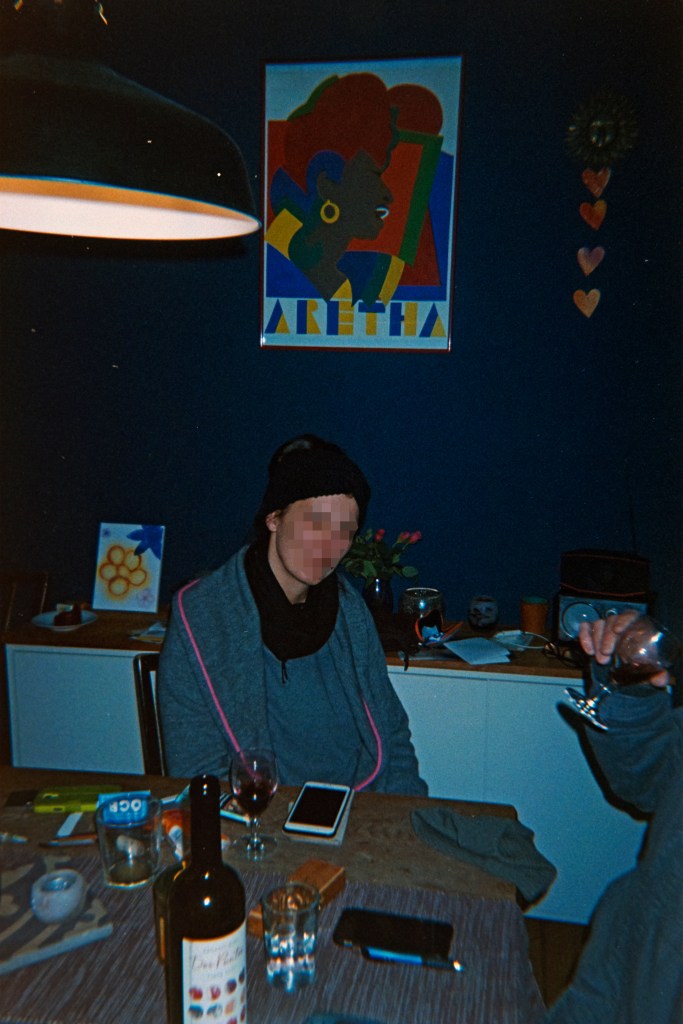

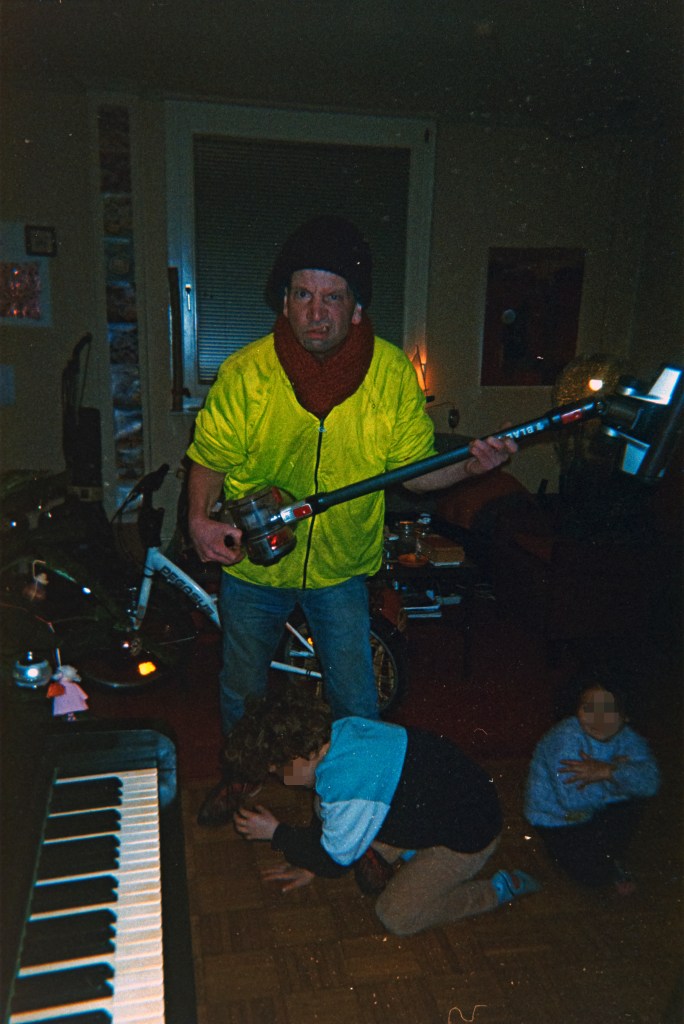
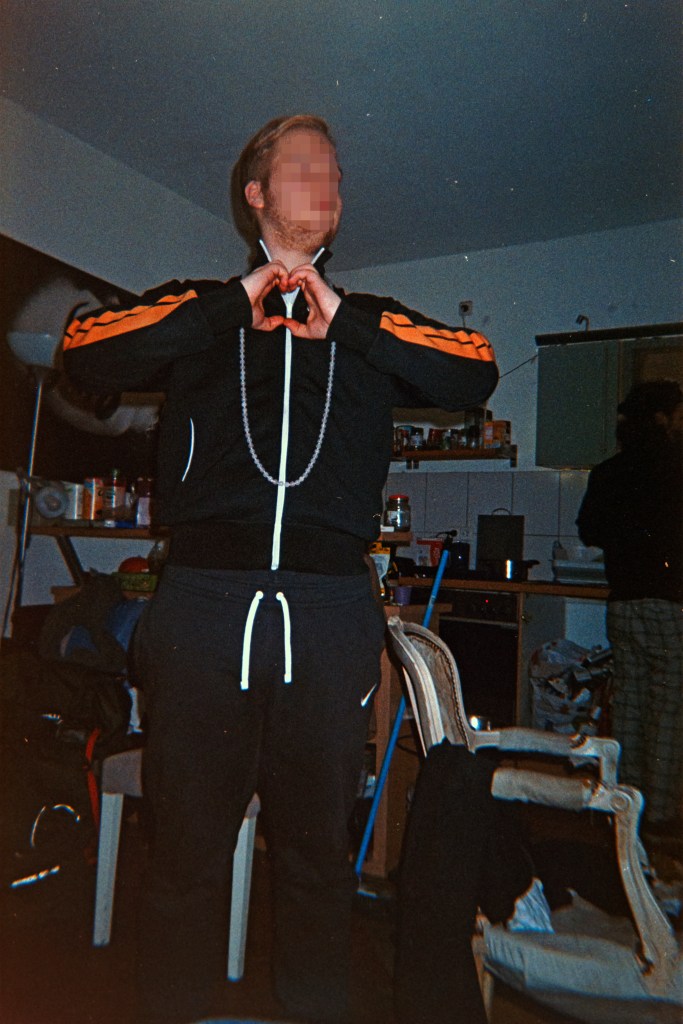
We go through the pictures. In every photo: people. Florian laughs a lot while looking through them, he is enthusiastic. „Who is that?“, I ask at almost every picture. „Holger, a great musician, cellist, bass player, teacher, super guy.“ The next photo: a friend of his and his children. And who is that? „Uncle Pommi, the taxi driver, the legend. He has a huge heart, he’s totally sweet.“
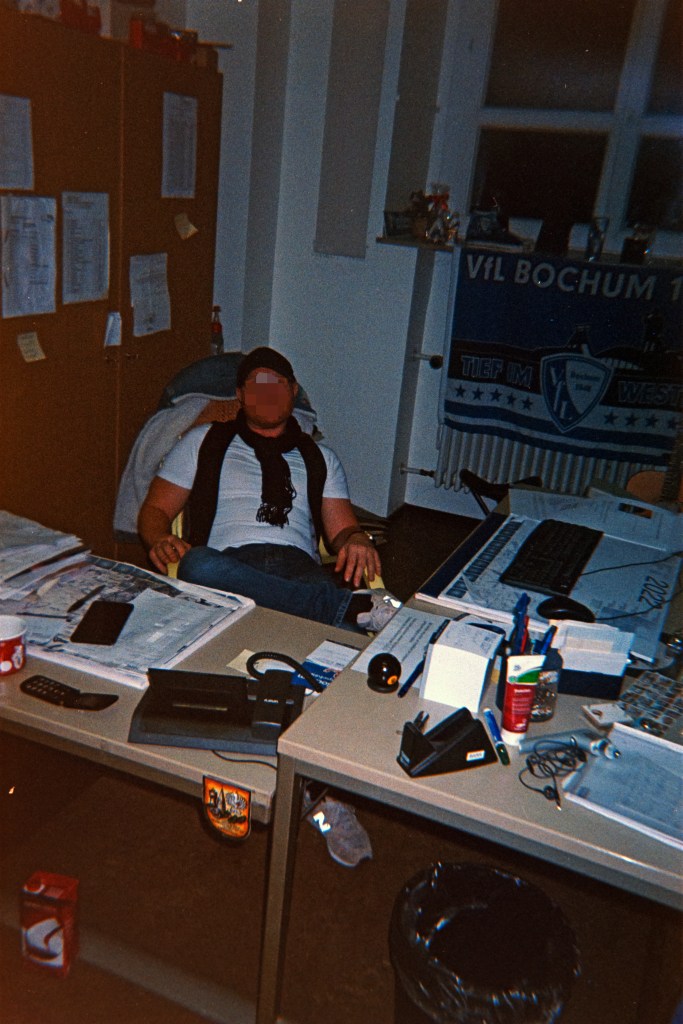
The next picture is a photo of „Tommy the Tomato“, a caretaker at a school in Essen, at his workplace. „Why did you visit him there?” – “Because I often visit him there, just like that. And because he’s really good at it and everyone loves him. And then he sits there. Just sits there.“ It goes on – random people he met. Again and again, pictures of his son, who is there when Florian meets up with friends. An acquaintance, the photo was taken at his home.

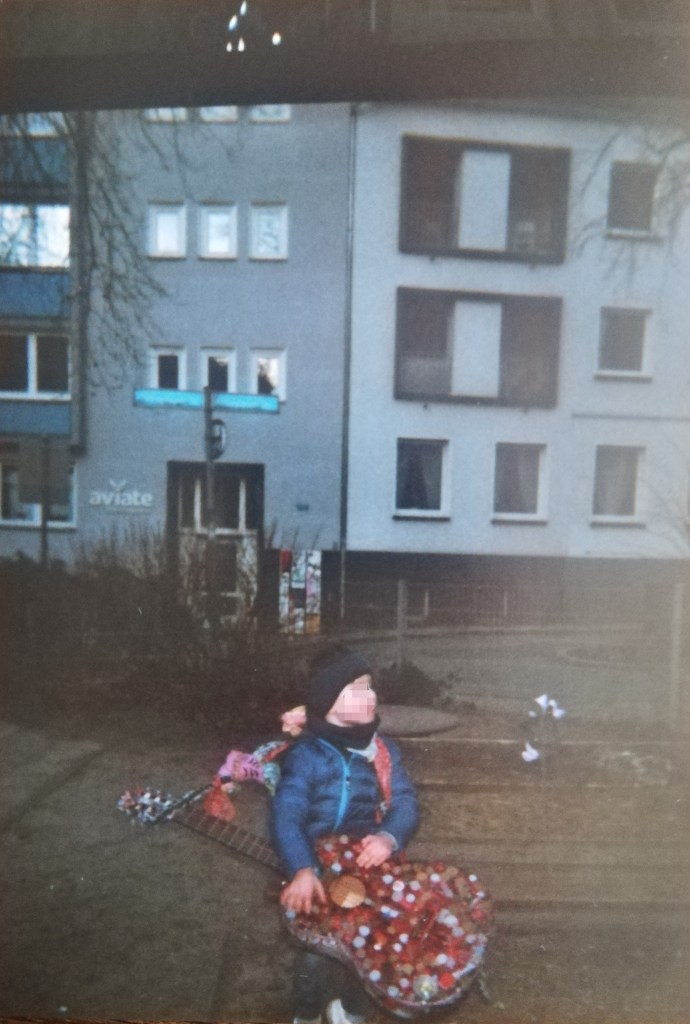
A professional flautist. The next photo: an old friend of his. „We have a lot of memories together, when you were still a poopie poopie girl in kindergarten, we were already kicking ass in the city. He was always the dreaming man. We sold a lot of cheese sandwiches at demolition house techno parties. We were such entertaining cheese sandwich sellers. We always got a lot of coins, the income was negligible. Then we always went to the next bar with a suitcase full of our cheese sandwich sales revenue and just danced and spent the whole suitcase. That was a very nice time. We sang in hospitals, both of us, in those days.“ The next picture was taken in front of the kiosk. Then: a well-known singer and his girlfriend. Strangers he met outside the pub. „Ah, skater boy, a hipster from the Südviertel, great guy, super nice.“ His son again, a photo of the two of them together. „My son always has to make gestures like that.“ A toddler pulling on his guitar.

All the photos show Florian among people, very different people, just like always. What does the square he always spends time in and the people he has photographed mean to him? „Well, this is the most beautiful square in the city, in my opinion. It’s the only space where people of all colours meet. Yes, and there’s always something different happening. And you meet, or you don’t. You run into each other, or you don’t. Children and older residents and families and would-be artists and all that – they’re all there.“ I ask him if he would like to tell me a bit more about his gang, which he has photographed and about which he wants to write a book. „Yes, the gang, that’s the mafia of love, it’s simply about saving the world. And if they don’t, they don’t. And they come together, and they’re kids, they’re adults – adults, what a shit word is that? They’re little kids and big kids, old kids and young kids. And basically, in the sense of ‚The Animals‘ Conference‘ by Erich Kästner, it’s about the fact that someone should finally set out to completely make the world more beautiful, more loving, more concrete, stronger and sunnier. We can do that, really, it’s no problem at all. All you have to do is meet the right people in life and the rest will take care of itself.
 Projekt "Perspektive(n) Mensch"
Hinterlasse einen Kommentar